April 06, 2012
By: NCVeditor
Category: Culture, Matt Meyer, Politics
Removing ‘War’ from the History Books?
by Matt Meyer
As any good teacher should do on weekends, I have been preparing for my New York State Regents-based course in United States History. In light of last week’s revelations that the New York City Department of Education (the largest such public bastion of  knowledge in the country) has sent out a list of proposed words to be avoided in the creation of tests, the scope of my new curriculum might end up looking something like this:
After the Revolutionary Skirmish of 1776, there were great debates about the founding principles of the new nation. As the thirteen colonies became thirteen states, questions of representation became especially heated when Southern state leaders asserted the need for the continuation of freedom-less-ness for people of African descent. Eventually, a Civil Hostility took place, which saw an end to vassalage. This helped pave the way for the US to become an even more respected power, but it did not truly become an international force until involvement in World Big Fight One. Read the rest of this entry →
Comments (9)
April 05, 2012
By: NCVeditor
Category: Community, Culture, Diane Lefer, Economy
Seeking Unity Across Sex, Race, and Class
by Diane Lefer
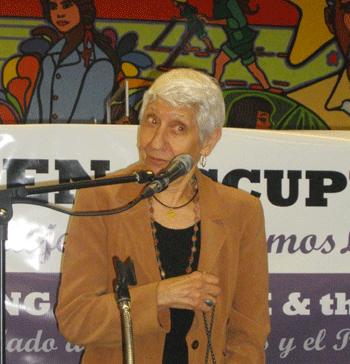
In an era when we see the faces of women, people of color, gay and lesbian people and people with disabilities among the 1%,”All the movements we have founded for our liberation are now represented in the establishment,” said women’s rights and anti-racist activist 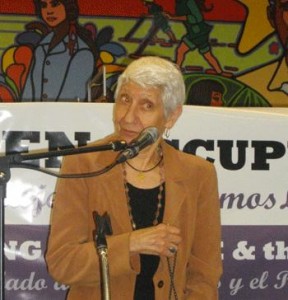 Selma James, “but we are not.”
And we remain unlikely to prevail without unity.
James, born in New York, one-time resident of South LA, veteran of anti-colonial struggles in the Caribbean, and now UK-based, was back in the US to launch her new book, Sex, Race and Class — The Perspective of Winning. As the keynote speaker at the Teach-In, “Sex, Race & Class: What Are the Terms of Unity?” on Saturday, March 24 at the Southern California Library in South LA, she drew on  decades of organizing experience to talk about how to bridge the divide among the different sectors that make up the 99%.
The answer may well be “Money.” Not as the root of all evil, but the source of both autonomy and commonality. Read the rest of this entry →
Comments (2)
April 04, 2012
By: NCVeditor
Category: Culture, Current Events, Robert C. Koehler
Finding the Wisdom We Need to Survive
by Robert C. Koehler
I’m far more interested in forgiveness than justice.
I say this just to calm myself down after a morning of media overkill, so to speak. There are so many murdered mothers and children in the news, some with names and faces, so many just adding anonymously to one death toll or another.
 An Iraqi mom, 32 years old, is beaten to death in her house in El Cajon, Calif. A note by her body reads: “Go back to your country, you terrorist.†Was it a hate crime? An isolated incident?
The guy who killed Trayvon Martin is still at large, somewhere. But his 2005 mug shot is everywhere, making him the poster child of vigilante justice. Do I have to reduce the killer to that viral scowl to feel compassion for Trayvon?
Dehumanization, the death of the human soul, is now reaching an advanced stage and its consequences are spreading across the country and the planet like global warming. I feel my own immune system breaking down. I can’t absorb the news anymore without hearing a deep alarm go off somewhere, insistent, berserk.
It’s not just the violence. Violence is a symptom — of social brokenness, alienation, profound disconnection at so many levels, perpetuated by our institutions and popular culture.
Read the rest of this entry →
Comments (3)
April 03, 2012
By: NCVeditor
Category: Culture, Ecology, Economy, Randall Amster
Averting the ‘Total Ruin’ of Institutionalized Injustice
by Randall Amster
As a parent, I tend to keep one eye on the present and another on the future. I also keep one (the third eye, perhaps?) on the past, since we need to know where we’ve been to know where we’re going. Or so they say — I’m actually not convinced that history is an  accurate predictor any longer in this brave new world we’ve created in relatively short order. Then again, we in the Western world have always perceived the inevitability of an apocalypse of our own creation, from the very moment we decided to flout natural laws in favor of our manmade shackles. So maybe the past does matter.
But it’s the present and immediate future that most concern me these days. Or, more precisely, the ways in which the present is foreclosing, narrowing, and perhaps even mooting the future.
My children are growing up in a world of apparent plenty and wondrous stimulations, but it all comes at the cost of rendering the continued existence of the species — even possibly within the scale of their lifetimes — seemingly speculative at best. Their bubble of ostensible freedom and perceived luxury also comes at the expense of the wellbeing of most of the planet’s inhabitants, including the children of other parents whose capacity to mask the mounting horror is likely far less than mine. Read the rest of this entry →
Comments (10)
April 02, 2012
By: NCVeditor
Category: Culture, David Smith-Ferri, Politics
Above the Drone of War, Voices for Peace Rise in Afghanistan
by David Smith-Ferri
In 1876, at the so-called Battle of the Little Bighorn when U.S. Cavalry regiments attacked an Indian village along the Little Bighorn River in Wyoming, the first casualty was a ten-year old Lakota Sioux boy named Deeds. Unaware that U.S. troops were nearby  planning an attack, he and his father were combing a hillside looking for a lost pony when U.S. troops encountered and killed him. The next casualties were six Lakota women and four children, who were murdered while in a field gathering wild radish bulbs, one of the many indigenous plants that Native people depended on for their livelihood, and hardly a threatening activity.
I think of these events today because of the recent killings of Afghan civilians, not only the 17 women and children killed in villages outside Kandahar, but also two recent and less publicized atrocities resulting from NATO airstrikes that killed civilians in Kapisa Province, including eight Afghan boys who were tending their sheep. Sheepherding, of course, is an activity as integral to their livelihood as gathering indigenous plants was to Lakota people. Read the rest of this entry →
Comments (6)
March 30, 2012
By: NCVeditor
Category: Family, Joel Olson, Politics
Mourning the Loss of a Colleague, Comrade, and Friend
We are deeply saddened by the loss of esteemed activist, writer, scholar, and NCV Contributor Joel Olson, who passed away while on sabbatical in Europe.
 Joel was Associate Professor in the Department of Politics and International Affairs at Northern Arizona University in Flagstaff, Arizona, where he specialized in political theory. A noted expert on racial politics and extremist ideologies, he was the author of The Abolition of White Democracy (University of Minnesota Press, 2004) as well as numerous articles and reviews. Joel was working on a second book, entitled American Zealot: Fanaticism and Democracy in the United States, at the time of his death.
During the 1990s Joel was involved with the Love and Rage Revolutionary Anarchist Federation and later went on to form Bring the Ruckus! He was a well-known figure in the anti-racist and pro-immigrant movements in Arizona, working with grassroots groups including Copwatch and the Repeal Coalition. Read the rest of this entry →
Comments (12)
March 30, 2012
By: NCVeditor
Category: Culture, David Swanson, Politics
Moving from ‘Lesser Evil’ to ‘Greater Good’
by David Swanson
I think two opposing trends have been at work in U.S. history. One is that of allowing more people to vote. This is an ongoing struggle, of course, but in some significant sense we’ve allowed poor people and women and non-white people and young people to vote. The  other trend, which has really developed more recently, is that we’ve made voting less and less meaningful. Of course it was never as meaningful as many people imagine. But we’ve legalized bribery, we’ve banished third parties and independents, we’ve gerrymandered most Congressional districts into meaningless general elections and left one party or the other to exercise great influence over any primary. Rarely does any incumbent lose, and rarely does a candidate without the most money win. Extremely rare is a winning candidate who lacks some major financial backing. Rarer still is a candidate who even promises to pursue majority positions on most major issues, or who convincingly commits to following the will of the public over the will of the party. Most Congress members are pawns in a government with two partisan voices, not the voices of 535 individual representatives and senators. Rare, as well, is any possibility in a close primary or general election of verifying the accuracy of a vote count. Read the rest of this entry →
Comments (6)