July 27, 2017
By: NCVeditor
Category: Community, Culture, Current Events
We’ll See You in the Interwebs
This likely won’t come as a shock to anyone, given the dearth of activity on the site in recent times, but we’re going to put this project on an extended/permanent hiatus. We’ll still keep the articles (over a thousand, remarkably!) in our archive and the site will stay online and accessible. Indeed,  the themes and topics we’ve covered here are eternally relevant — and we’ve said quite a lot on them.
Our most sincere thanks go to you, the readers, for supporting this journey since 2010 and helping to make this project a meaningful experience for all concerned. When we started this, the blogosphere was still somewhat sparsely populated, especially from the progressive side of things. Today, with the proliferation of media and movements alike, there are fortunately many options.
The incredible contributors to this space will continue to do their critical work in the world through many platforms, so look for them out there in the web/world. And please, whatever else ensues, do not abandon the essential spark of hope and possibility that has animated this site over the years. The world will keep turning, we’ll keep growing, and there’s always a place for a new clear vision…
PEACE
Comments Off on CODA
April 26, 2017
By: NCVeditor
Category: Devon G. Pena, Ecology, Economy
Whose Interests Are Being Served?Â
by Devon G. Peña
I consider myself an “ethno-scientist.†The methods and practices I follow in the fields of agroecology, ethnoecology, and related areas reflect my grounding in millennia of indigenous knowledge and study of ecological processes in the human-nature interrelationship. The two 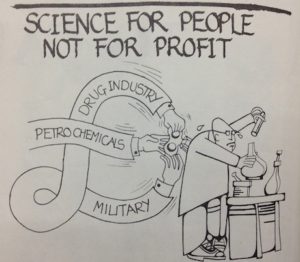 cultures divide that C. P. Snow lamented because it separates the humanities from the natural sciences remains a central concern for me as a practitioner of community-based collaborative and interdisciplinary research.
Yet, I did not participate in the March for Science. And it is not because I am anti-science. I am against continued widespread reductionism of and in science (e.g., the geneticization of all phenomena); I am against continued service of scientists in the capitalist control of knowledge production and the deployment of technologies that place our health, safety, and well-being at higher risk. I am certain many of the scientists who marched will feel the same way; but this is a minority worldview. Read the rest of this entry →
Comments Off on Why I Didn’t March for Science
April 20, 2017
By: NCVeditor
Category: Current Events, Politics, Robert C. Koehler
It’s Time to Give Peace a Chance
by Robert C. Koehler
Sometimes our tame and compliant media upchucks a piece of truth. For instance:
 “American officials had predicted that the missile strike would result in a major shift in Assad’s calculus, but the U.S. attack appeared to be symbolic in reality. Within 24 hours of the strike, monitoring groups reported that warplanes were again taking off from the bombed Shayrat air base, this time to attack Islamic State positions.â€
This paragraph in a Washington Post story refers, of course, to the 59 Tomahawk cruise missiles Donald Tr$mp earned such plaudits for launching against Syria on April 7. Suddenly he was our commander in chief, waging war — or, well . . . waging “symbolic reality,†whatever that means, at a cost (for the missiles) of maybe $83 million and change. Read the rest of this entry →
Comments Off on Beyond Redemptive Violence
March 20, 2017
By: NCVeditor
Category: Community, Current Events, Politics, Randall Amster
Beyond Our Winter of Discontent
by Randall Amster
Spring may be upon us, but the prevailing political winds foretell a long, cold season ahead. We’re two months into the Tr$mp presidency, and the template has been set: incompetence, intolerance, scandal, strong-arming, divisiveness, duplicity. If America was longing for a “reality show†at the  top of the news queue, this moment certainly fits the bill — but this is actual reality, and as time passes the damage being done will only increase in its potential to have long-term corrosive effects. And this may well include the likelihood that this Administration’s conflict-centric ethos will manifest in a full-on war soon enough.
If that happens, all bets are off as to what ensues. For those with slightly longer memories, you may recall George W. Bush getting off to a shaky start, with a series of missteps and a penchant for being more interested in golfing than governance. Granted, this is a different era and context, and the players are different — to such an extent that Tr$mp almost makes Bush seem reasonable by comparison (yet not). In many ways, we’re living with the direct consequences of the Bush years, and Tr$mp is the clear beneficiary of a playbook that calls for an imperial presidency and blatant disregard for the Constitution. Read the rest of this entry →
Comments Off on Spring Forward
March 10, 2017
By: NCVeditor
Category: Current Events, Nancy Mattina, Politics
You’ve Got to Fight for Your Rights…
by Nancy Mattina
Pine if you will for the eloquence, dignity, and erudition of our 44th President. Tragically, history will not accord him the status of a transformative political figure. What our highly selective record of accident and argument will show is that our first African-American Commander-in-Chief took  the stage when our country was wracked with economic apartheid, spawn of greed. His response was cautiously pragmatic. He assumed that the nation would come to its middle class senses once the immediate crisis had passed. For maintaining his faith in capitalism and American exceptionalism he was jeered by the right as dictatorial and cowardly, by the left as fatally compromised.
Obama’s cool as he stood alone in the cloaca of party politics made him a culture-hero. But his style and personal belief system did not translate into faith in the political party he represented. More like us than not, the Democratic Party ran the last election as if a moral victory guaranteed an electoral one. With Obama gone, electoral defeat has never been more consequential. Read the rest of this entry →
Comments Off on Party Time
March 06, 2017
By: NCVeditor
Category: Angeles J. Maldonado, Community, Current Events, Politics
Community Action and Immigration Justice
by Angeles J. Maldonado
{Editor’s Note: The following is adapted from a presentation for a keynote panel at the “Local to Global Justice†Conference at Arizona State University. The arrest referenced in the narrative refers  to the physical blocking of a government van that was in the process of transferring Guadalupe Garcia de Rayos, an undocumented immigrant woman, to a detention facility so that she could be processed for deportation, after she was detained at the ICE offices in Phoenix during what was supposed to be a routine immigration check-in. Seven were arrested on charges of obstructing governmental operations and obstructing a public thoroughfare: Walter Staton, 35; Manuel Saldana, 31; Beth King, 57; Angeles Maldonado, 36; Maria Castro, 23; Kenneth Chapman, 41 and Luke Black, 37. Garcia de Rayos was ultimately deported to Mexico, but her case illustrates the problematic intricacies of immigration law and the new executive orders by President Tr$mp, which make people like Garcia de Rayos a deportation priority.} Read the rest of this entry →
Comments Off on On Disruption
March 04, 2017
By: NCVeditor
Category: Community, Education, Laura L. Finley
Sexual Assault, Justice, and Just-ness
by Laura L. Finley
I, like many sexual assault advocates, have struggled with two competing feelings about the harshness of the criminal justice system versus the treatment of rapists. On one hand, I believe in second chances, am critical of the prison industrial complex, and disavow mass incarceration as an  alleged “solution†to crime. I am especially troubled by the racism of our criminal justice system, which has resulted in the incarceration of far too many black men. On the other hand, the gentle treatment given to sexual assailants brings tears to my eyes.
Given that it is incredibly difficult for a victim to not only report sexual assault but also to undergo the terrifying and humiliating physical examination, then to endure the victim-blaming that inevitably occurs in the courtroom, I find myself disturbed by the ridiculously light sentences handed down to individuals who are guilty. Of course, even worse are those who never face any punishment, which is some 97 percent of rapists. Below are just a few instances to illustrate how the courts minimize sexual assault. What is notable is that the perpetrators are privileged white males. Yet advocating harsh sentences inevitably has a more significant impact on people of color than on these white males. Hence the dilemma—but, perhaps these binary options are not the only ones before us. Read the rest of this entry →
Comments Off on Is There Another Way?

