October 19, 2012
By: NCVeditor
Category: Culture, Economy, Mary Sojourner
There’s No Such Thing as a Corporate Courtesy
by Mary Sojourner
“You can’t put a price on sensory experiences. They are so invaluable and so total.†— Hyatt Regency Scottsdale spokeswoman, Arizona Republic, Business, May 31, 2007
 Totally. The wordsmith read the article on Hyatt’s plan to use soundtracks in their lobby, bars, restaurants, and spas. Five compilations are available on their website for download. One can download fifteen songs for $22. The first artist named was Thievery Corporation. I did not make that up.
The article pointed out that some properties were also “dabbling in branding tools….†Bend over and pull down your pants, tourist. We gotcha. Read the rest of this entry →
Comments (4)
October 18, 2012
By: NCVeditor
Category: Ecology, Martin Zehr, Politics
California Now Has Water as a Human Right — Or Does It?
by Martin Zehr, aka Mato Ska
The headlines read: law passed in California to make water a human right. AB685 does indeed have that language but California is far from that as a reality. The question really is whether this is a real breakthrough or whether it presents the potential of a creating a  new maze of litigation in the future. From looking at the language of the bill, it would be a profound mistake to consider this a victory for poor people or an acknowledgement of their basic survival needs. It needs to be said that there are so many questions raised by such a law that are not addressed in the law that it will assuredly result in profound impacts on farmers and farm workers throughout the state of California.
Water as a Human Right has to be defined in the context of both drinking water and food production. Read the rest of this entry →
Comments (3)
October 17, 2012
By: NCVeditor
Category: Culture, Economy, Politics, Randall Amster
Blinded by the Light of an Electoral ‘Reality Show’
by Randall Amster
Coming up next on ‘The Oval Office’: sparks fly as the final two contestants go head-to-head on live TV, while a dramatic surprise will soon be revealed that could change everything — and YOU get to make the call on who wins the grand prize and who gets voted off the show. Stay tuned…
 One can almost hear the narrator’s voiceover as the news is reported and the debate is joined. Presidential politics, and media-age elections in general, more closely resemble an illusory ‘reality show’ than any substantive engagement with the critical issues of the day. If the Association of National Advertisers could select Barack Obama as ‘Marketer of the Year’ for 2008, then perhaps this year will bring another level of media acknowledgment. Joe Biden for an Emmy, anyone? Read the rest of this entry →
Comments (5)
October 16, 2012
By: NCVeditor
Category: Culture, Current Events, Jennifer Browdy
Malala Yousafzai Stands Up for Us All
by Jennifer Browdy de Hernandez
There are a couple of old saws that I was taught as a young journalist, which I continue to pass on to my media studies students now.
 One is: if it bleeds, it leads.
And another: one powerful human interest story is worth a million statistics.
We saw both of these principles in action with the news of Malala Yousafzai, a 14-year-old Pakistani girl who New York Times columnist Nicholas Kristof calls “one of the world’s most persuasive advocates for girls’ education.â€
Everyone probably knows by now of how the Taliban viciously shot Malala in the neck as punishment for her outspoken insistence that girls should be allowed — and indeed, encouraged — to go to school, just like boys. Read the rest of this entry →
Comments (2)
October 15, 2012
By: NCVeditor
Category: Culture, Politics, Robert C. Koehler
The Morality of Domination Has Caught Up to Us
by Robert C. KoehlerÂ
Ever notice the way certain basic human values quietly transform into their opposite on their way to becoming national policy?
 At the human level, the immorality of murder is fundamental, and most people understand the insanity of armed hatred. Keeping these dark forces under wraps is essential to the existence of human society. So why is it, then, that at the abstract level of nationalism, those forces are honored, worshiped, saluted, extolled as glorious, and given command of an enormous budget?
Why is it that their perpetuation via increasingly sophisticated technology is equated with national security and no one talks about the completely predictable negative consequences of basing security on murder and hatred?
And why does it feel so naïve to be asking such questions? Read the rest of this entry →
Comments (5)
October 12, 2012
By: NCVeditor
Category: Community, Devon G. Pena, Ecology, Economy
Exploring the Roots of Urban Agriculture in MexicoÂ
by Devon G. Peña
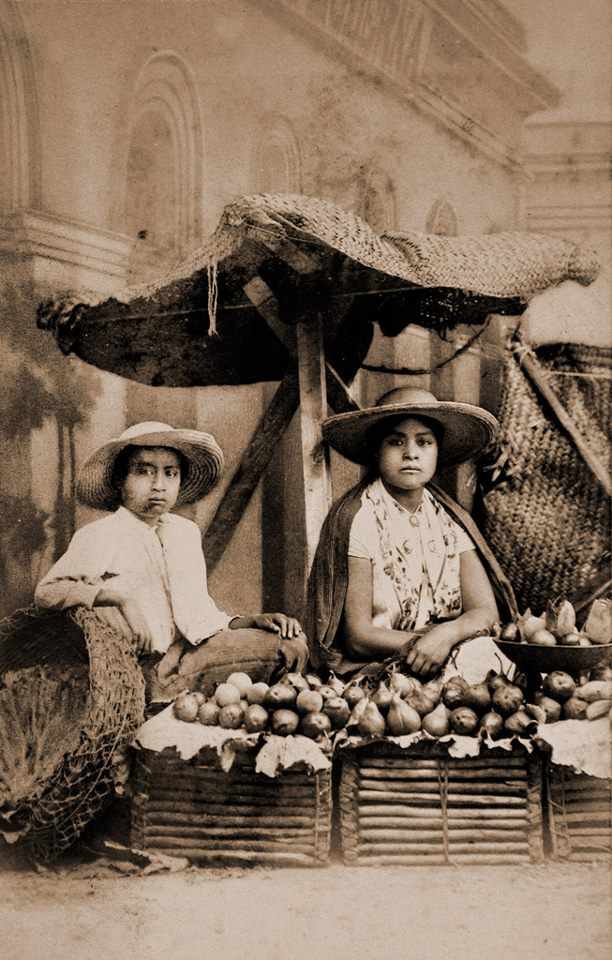
Every now and then a photograph really speaks more than a thousand words. The accompanying 1865 photograph shows two fruit and vegetable vendors in Mexico City. Judging from the architecture in the background, the photo was most likely taken inside the  historic core, perhaps close to the Zócalo.
A lot of commentary has been made about this photo. One thread of comments emphasizes the perceived poor condition of the ambulantes (mobile street vendors). How one can surmise this seems difficult but one comment posted recently to Facebook argues that the photograph demonstrates “The poor condition of the vendors, which can still be seen in the streets of Mexico City today.â€
However, even by today’s standards, these vendors actually look fairly well dressed and healthy. These lamentations about the urban poor strike me as betraying a modernist urban sensibility and class bias. If anything, given the source of the comments on Facebook, they illustrate a widespread failure, common to what I can only characterize as petit-bourgeois intellectuals, to understand that for many people street vending is as much a way to earn an income as it is a social and community-building activity — a way of life even. Read the rest of this entry →
Comments (7)
October 11, 2012
By: NCVeditor
Category: Current Events, David Swanson, Politics
Can It Still Save Us?
by David Swanson
For as long as there’s been a United States of America, its private citizens have done some of its best diplomacy. In 1798 Dr. George Logan eased tensions between France and this country. He got a law named for him, criminalizing such services, but nobody’s ever  been prosecuted under it — probably because the crime prosecuted would itself be the act of crime prevention.
One of my favorite cases, recounted in When the World Outlawed War, involved James Shotwell, who worked for the Carnegie Endowment for Peace (created by Andrew Carnegie to work exclusively on abolishing war, and currently working on everything but).
In 1927, Shotwell drafted a public statement for the Foreign Minister of France proposing to the United States the creation of a treaty criminalizing war. When few took notice, Shotwell’s colleague Nicholas Murray Butler wrote a response to the Foreign Minister in the New York Times. These two ventriloquists’ public diplomacy resulted in a treaty banning war to which the United States, France, and 79 other nations are party today. (Ssh! Don’t tell them.) Read the rest of this entry →
Comments (2)
 Totally. The wordsmith read the article on Hyatt’s plan to use soundtracks in their lobby, bars, restaurants, and spas. Five compilations are available on their website for download. One can download fifteen songs for $22. The first artist named was Thievery Corporation. I did not make that up.