October 30, 2012
By: NCVeditor
Category: Culture, Ecology, Evaggelos Vallianatos
On Religion and Technology in America
by Evaggelos Vallianatos
Garry Wills, professor of American history and author of Bomb Power, says that the atomic and nuclear bomb remade the country into a National Security State fostering perpetual emergency, secrecy and war.
 “Secrecy,” says Wills, “emanated from the Manhattan Project like a giant radiation emission.” Indeed, Wills argues very persuasively that the Manhattan Project turned out to be not merely a “fatal miracle” because it created the “awesome” bomb but also because of the processes it set in place:
“The military-industrial complex, with a poisonous admixture of government and secrecy, had scored a triumph that would show the way to many other governmental activities… The secrecy that had enveloped Los Alamos [building the bomb] would steal quietly across the entire American landscape in the years to come.”
According to Wills, the other inevitable result of the bomb was that it gave the president supreme power. He alone could decide the fate of the world.
Read the rest of this entry →
Comments (2)
October 29, 2012
By: NCVeditor
Category: Culture, Diane Lefer, Politics
New Film Focuses on Combating Military Sexual Trauma
by Diane Lefer
After The Invisible War,  a documentary about sexual assault in the US military, screened Thursday evening, a woman stood up from the audience to say she had just celebrated her 80th birthday and that, as a young woman, she’d been raped by a stranger. She wanted everyone to know that today she’s a happy person. Yes, she said to loud applause, “it is possible to heal.â€
 Healing, being able to move forward with their own lives, is surely what everyone wishes for survivors of sexual violence. But as documentary producer Amy Ziering suggested to the audience during the post-film discussion, in the military, it’s a lot harder to recover if you are far from home, have no support, are called a liar and threatened with retaliation or even death if you tell, and surely worst of all, have to report to your job the next day to the very person who raped you.
Kori Cioca was stalked and harassed by her commanding officer in the Coast Guard for weeks before he attacked her. Read the rest of this entry →
Comments (2)
October 26, 2012
By: NCVeditor
Category: Ecology, Economy, Sarah (Steve) Mosko
Are They Really a Solution?
by Sarah (Steve) Mosko
Bioplastics are simply plastics derived from renewable biomass sources, like plants and microorganisms, whereas conventional plastics are synthesized from non-renewable fossil fuels, either oil or natural gas. It’s a common misconception, however, that a  bioplastic necessarily breaks down better in the environment than conventional plastics.
Bioplastics are nevertheless marketed as being better for the environment, so how do they really compare?
The Problems with Petroleum-Based Plastics
The push to develop bioplastics emerges from alarming realities starting with the staggering quantity of plastics being produced, over 20 pounds a month for every U.S. resident, according to the latest numbers from the American Chemistry Council. Conventional plastics do not biodegrade (defined below) within any meaningful human timescale — they just break apart into smaller plastic fragments. This means that, except for a tiny fraction of plastic that is combusted for energy production, all plastic eventually ends up as trash, either in landfills or as litter. Read the rest of this entry →
Comments (4)
October 25, 2012
By: NCVeditor
Category: Community, Erin Niemela, Politics
NYPD ‘Stop-and-Frisk’ Practices Spotlighted in New Documentary
by Erin NiemelaÂ
“I will break your f**king arm off right now,†a New York police officer shouts. “You want me to smack you?†warns another. The exclusive audio is shocking and the first of its kind. It is the only known audio evidence of a NYPD stop-and-frisk in progress, recently  released in the documentary The Hunted and the Hated: An Inside Look at the NYPD’s Stop-and-Frisk Policy. The audio captures the experience of Alvin, a Harlem teen, who the police claim is being stopped for “being a f**king mutt.†For New York communities of color, the recording represents an every day experience, and it will undoubtedly fuel the stop-and-frisk controversy that has been brewing for several years.  Clearly, the aggressive and even violently intimidating behavior of some NYPD officers cannot be tolerated in a civilized society. Of course, not everyone agrees. The back story only exacerbates the conflict. Read the rest of this entry →
Comments (3)
October 24, 2012
By: NCVeditor
Category: Current Events, David Smith-Ferri, Politics
Sunrise and Sunset in Afghanistan
by David Smith-Ferri
October 7, 2012, Kabul, Afghanistan — At 5:15 a.m., the main street outside the Afghan Peace Volunteer’s (APV) apartment is quiet, and the first weak rays of gray light filter down through dusty, polluted air. In the distance, the hulking brown mountains circling the  Kabuli plain emerge ominously from darkness. After yesterday’s dust storm, a thin brown film covers everything: windows, the shop stall roofs where children fly kites in the evening, bicycle seats, burlap sacks protecting fruit and vegetable displays, doorknobs, throats, the leaves of trees. Early bicyclists and pedestrians make their way. A man pushes a wheelbarrow, and a black horse pulls a hooded rider and an empty wooden cart. Twenty minutes later, the first street vendors appear, blowing on their hands in the cold, and seating themselves on stools. They sit directly across from our apartment, and lift handfuls of thick, peeled carrots out of 40 kg. sacks. Hunched over, they grate the carrots into two rising, orange pyramids. All day, among the pervasive grays and browns and blacks of this neighborhood, these mounds of carrots are sunrise and sunset on the main drag. Read the rest of this entry →
Comments (2)
October 23, 2012
By: NCVeditor
Category: Politics, Robert C. Koehler
Summoning the Moral Equivalent of Nuremberg
by Robert C. Koehler
My favorite quote was from the British government spokesperson, who assured us: “All ammunition used by UK armed forces falls within international humanitarian law and is consistent with the Geneva Convention.â€
 Tears come to my eyes as I think about the kindness of coalition bullets, the empathy of coalition bombs — unlike, I’m certain, the ammo used by terrorists, which is cruel, which hates our way of life and wants only to destroy it.
Forgive me the sarcasm. Another study has come out, this one underwritten by the Department of Obstetrics and Gynecology at the University of Michigan, linking the U.S.-British war in Iraq with a hideous, heartbreaking and “staggering†increase in birth defects in areas of the country where bombing and heavy fighting occurred.
When does amorality turn to immorality? How bad must the crime of war reveal itself to be before those who wage it cease and desist, of their own volition or in deference to global outrage? Must an organized global power arise that so terrifies the leaders of nations they surrender to peace? I doubt that that’s how change will occur. Read the rest of this entry →
Comments (3)
October 22, 2012
By: NCVeditor
Category: Guest Author, Matt Meyer, Politics
New Visions for Egypt’s Ongoing Revolution
By Sherif Joseph Rizk (adapted from an interview with Matt Meyer)
There are many myths about the Egyptian Revolution — first and foremost that it was a success story based completely on the principles of strategic nonviolence. The main fact is that, though it was a mostly nonviolent effect, our only success was in getting rid of the dictator. The rule of the dictatorship, however, continues.
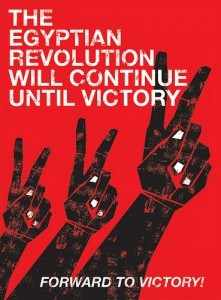 It is important to understand that during the uprisings of 2011, there were elements of confrontation that could be considered “borderline violence†— if you consider throwing back tear gas canisters or Molotov cocktails violent. There was plenty of that. I think there is a threshold that has to do with the proportionate use of force: if the force that is used to counter the opposite force is proportionate, it may not be appropriate to deem that force as violent. In the case of Egypt since 2011, I would say that the force used against the security state was disproportionately small, and therefore, by my standards, should be considered nonviolent. To confront a security state, one needs to throw back tear gas canisters, and though I wasn’t personally involved in those activities, I was close to others who were. I don’t think that’s violent — it is part of the ground tactics needed in confronting a security state.
Fortress Tahrir, during the 18 days when the square was occupied by the Egyptian people, faced many complicated tactical issues. One was how it might best be defended; it was being attacked on many levels by all sorts of challenges. Read the rest of this entry →
Comments (5)
 “Secrecy,” says Wills, “emanated from the Manhattan Project like a giant radiation emission.” Indeed, Wills argues very persuasively that the Manhattan Project turned out to be not merely a “fatal miracle” because it created the “awesome” bomb but also because of the processes it set in place: