Why I Didn’t March for Science
Whose Interests Are Being Served?Â
by Devon G. Peña
I consider myself an “ethno-scientist.†The methods and practices I follow in the fields of agroecology, ethnoecology, and related areas reflect my grounding in millennia of indigenous knowledge and study of ecological processes in the human-nature interrelationship. The two 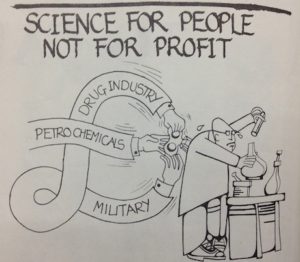 cultures divide that C. P. Snow lamented because it separates the humanities from the natural sciences remains a central concern for me as a practitioner of community-based collaborative and interdisciplinary research.
Yet, I did not participate in the March for Science. And it is not because I am anti-science. I am against continued widespread reductionism of and in science (e.g., the geneticization of all phenomena); I am against continued service of scientists in the capitalist control of knowledge production and the deployment of technologies that place our health, safety, and well-being at higher risk. I am certain many of the scientists who marched will feel the same way; but this is a minority worldview. (more…)
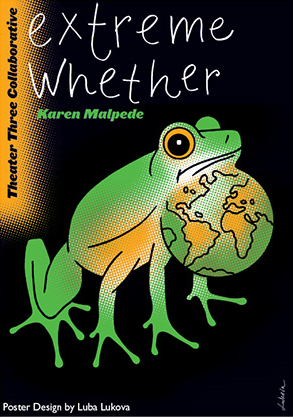 So, I already had a weird sort of family relationship to Hansen, whom I’ve never met, before I read Extreme Whether, a new play by the brilliant Karen Malpede that tells a personal story of Hansen in which everything is also political.
 Myriad Genetics, which claimed that it held ownership of a gene that is associated with breast cancer. Use this link for the full text of the ruling: Association for Molecular Pathology, et al v. Myriad Genetics, et al.
 Medical Association (AMA) and its Council on Science and Public Health. Here’s the proffered quote, which reveals the current dominant discursive frame used in defense of transgenic food safety: