The Great Mobilizer
Hope in the Face of Injustice
by Erin Niemela
The International Center on Nonviolent Conflict recently hosted the James Lawson Institute in Nashville, Tenn. The first event of its  kind, the Institute is an eight-day intensive training for North American organizers and activists, hosted by none other than Rev. James Lawson, himself an iconic figure of the Civil Rights movement. I was among 45 applicants afforded the opportunity to attend, notable activists and organizers from a variety of causes and campaigns (all of them far more experienced and courageous than I consider myself, to be sure). What I went there hoping to learn about civil resistance is nowhere near as important as what I actually gained: a profound sense of hope for the future of this world, this powerful group we call the people.
Our teachers included Rev. James Lawson, an instrumental figure in the Civil Rights Movement, Ivan Marovic, a leader of Optor!, the Serbian nonviolent revolution of 2000, and Mary King, an inspirational woman who worked in the pre-eminent Student Nonviolent Coordinating Committee during the Civil Rights Movement. We underwent four 14 hour-per-day trainings, covering historical cases, strategies, tactics, and movement cultures, among other more sensitive topics such as privilege, systemic oppression in movements, sustainability, burnout and dealing with interpersonal conflict. The intensity of these discussions had been set too high and left there permanently with little reprieve, and I found myself asking some existential questions: Who am I? What is my purpose? Where am I going? (more…)
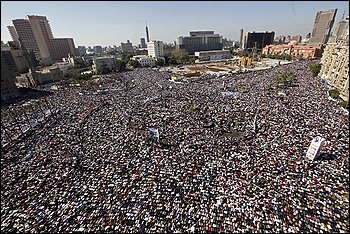 complexity of Egypt’s ongoing revolutionary moments will not lend themselves easily to short statements or translated sound bites . . . but we remain distant from, declarative regarding, or dispassionate about these events at our own grave peril. Nothing less than our collective, twenty-first century understandings of such terms as “democracy,†“revolution,†and “violence/nonviolence†are being forged on the streets of Egypt today.
 Corrections and Reform’ (CDCR) reported 30,000 participants statewide, which theÂ
Corrections and Reform’ (CDCR) reported 30,000 participants statewide, which the  “Blessed are they that suffer persecution for justice’ sake, for theirs is the kingdom of heaven.” Perhaps that’s why it’s so fitting that I’ve partnered with a minister to join theÂ
“Blessed are they that suffer persecution for justice’ sake, for theirs is the kingdom of heaven.” Perhaps that’s why it’s so fitting that I’ve partnered with a minister to join the  So I sat down yesterday to think about what connects global hot spots, and the first obvious answer I thought of for a great many of them was the United States military. By some strange coincidence numerous war-torn places on the globe have been given or sold weapons or sent troops or been visited by airplanes or drones courtesy of the same nation that spends the most on its military, keeps the most troops stationed in the most countries, engages in the most conflicts, sells the most weaponry to others, and thumbs its nose most blatantly at the use of courts to restrain its warmaking or even, any more, to put individuals on trial who can just as easily be hit with a hellfire missile. When I heard that our government had set up an atrocities prevention board, I immediately pictured a 2×4 being stuck through the door handles at the Pentagon to keep the place closed.  That would truly be an atrocities prevention board.
  River watershed north of Seattle, does count with a prosperous fruit and vegetable agricultural industry. Of course, the industry relies on mostly migrant families for farm labor. This is especially the case during harvest work and strawberry crops present an opportunity for workers to seize the current condition of ‘labor scarcity’ and high demand for skilled pickers during harvest time to organize for their workplace rights. And that is exactly what has happened in the State of Washington, and not in the Yakima or Wenatchee valleys but on the western side of the Cascades where peri-urban farming is increasingly big business.
