Why I Didn’t March for Science
Whose Interests Are Being Served?Â
by Devon G. Peña
I consider myself an “ethno-scientist.†The methods and practices I follow in the fields of agroecology, ethnoecology, and related areas reflect my grounding in millennia of indigenous knowledge and study of ecological processes in the human-nature interrelationship. The two 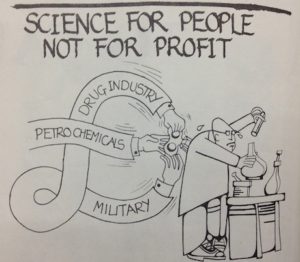 cultures divide that C. P. Snow lamented because it separates the humanities from the natural sciences remains a central concern for me as a practitioner of community-based collaborative and interdisciplinary research.
Yet, I did not participate in the March for Science. And it is not because I am anti-science. I am against continued widespread reductionism of and in science (e.g., the geneticization of all phenomena); I am against continued service of scientists in the capitalist control of knowledge production and the deployment of technologies that place our health, safety, and well-being at higher risk. I am certain many of the scientists who marched will feel the same way; but this is a minority worldview. (more…)
 to the physical blocking of a government van that was in the process of transferring Guadalupe Garcia de Rayos, an undocumented immigrant woman, to a detention facility so that she could be processed for deportation, after she was detained at the ICE offices in Phoenix during what was supposed to be a routine immigration check-in. Seven were arrested on charges of obstructing governmental operations and obstructing a public thoroughfare: Walter Staton, 35; Manuel Saldana, 31; Beth King, 57; Angeles Maldonado, 36; Maria Castro, 23; Kenneth Chapman, 41 and Luke Black, 37. Garcia de Rayos was ultimately deported to Mexico, but her case illustrates the problematic intricacies of immigration law and the new executive orders by President Tr$mp, which make people like Garcia de Rayos a deportation priority.}
 alleged “solution†to crime. I am especially troubled by the racism of our criminal justice system, which has resulted in the incarceration of far too many black men. On the other hand, the gentle treatment given to sexual assailants brings tears to my eyes.
 implications not only in terms of policies and principles, but also for the cultural messages it sends about acceptable behaviors and ideologies. And it’s not about political parties — assuming that construct can be pluralized anymore, with the power of the corporate purse strings tethered to those equivalently across the aisle.
 in the long-term is an end to the death penalty in the US. In the short term, however, my hope for January is that the jury that sentences Dylann Roof chooses life over another death.