Pledging Resistance
With Allegiance to a Better World in the Making
by Robert C. Koehler
I pledge allegiance to . . . what?
The Electoral College, to no one’s serious surprise, voted Donald Tr$mp in as the nation’s 45th president, and the pot of outrage in the American spectator democracy begins to boil.
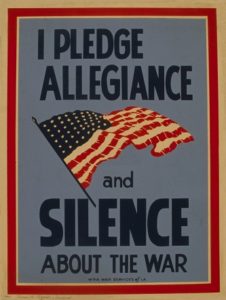 No, no, no, no, no, no, no — no to all his right-wing and idiotic cabinet and Team Tr$mp appointments, no to his conflicts of interest and serial tweets, no to his sexism, his reckless arrogance, his ego, his finger on the nuclear button.
The word of the day is resistance. For instance, Nancy Altman and Ira Lupu, writing at Huffington Post, point out that Tr$mp, though legally the new American president, lacks political legitimacy, thanks to widespread voter suppression, his huge loss in the popular vote and the anachronistic absurdity of the Electoral College; and even more disturbingly, is a thin-skinned, dishonest, immature jerk, utterly lacking the moral authority a national leader must project. These are flaws that cannot be ignored.
“Other elected officials, the media, and the citizenry at large have no obligation to afford him the slightest political respect,†they write. “Rather, the next four years should be a time of resistance and outright obstructionism. Opponents of Tr$mp should be at least as aggressive in challenging the political legitimacy and moral authority of his presidency as Republicans were in disrespecting President Obama, whose political legitimacy and moral authority were beyond reproach.†(more…)

 payments.â€
 agreements with indigenous peoples. Then these legal documents are little more than lip-service, or so it seems, based on the actions of the U.S., Canadian, and other governments who have and continued to trample the rights of indigenous peoples with impunity. Instead of being held accountable to the legally binding agreements they have signed, these governments continue to deprive indigenous peoples of their land, their livelihoods, and their cultures. Worse yet, they have the gall to point the finger at indigenous peoples and their allies who resist this continued destruction of their land and resources, calling them the criminals.
  the central cause of the Arab Spring of 2011.  In Syria, the drought of 2006-2011 left 75% of farmers from the northeast and south with total crop failure. He writes that: “According to the UN, 800,000 Syrians had their livelihoods totally wiped out.  One researcher notes that ‘the single factor that triggers riots around the world is food.’â€Â  In 2007, 48 countries experienced food riots.
 express the one and only part that they truly own, the only thing that connects them to their ancestors – their heritage and a sense of where they belong and who they are? Hundreds of thousands of Native American children were forced to attend Indian [sic] boarding schools where they were forbidden to speak their native languages. As a result Native American cultures have suffered grave harm and in some instances this has led to disappeared languages and extinct ways of life. However, a good people cannot be kept down for long and we are in the midst of decades-long and ever-widening resurgence of indigenous languages and heritage.
  intensified with the growth of tourism and, especially, eco-tourism, which has become deeply entangled with this region. Anthropologists and other social scientists have joined the debate. Honey (2009) looked at so-called community eco-tourism at the national level and reveals numerous shortcomings, but is still in favor of the promotion of tourism and seeks equitable distribution of economic assets to more directly benefit the indigenous communities.
