Against Resilence
The Katrina Disaster and the Politics of Disavowal
by John Clark
FORGETTING COMMEMORATION
A few weeks ago, New Orleans went through the ten-year commemoration of the Hurricane Katrina disaster. In fact, there were several quite divergent modes of commemoration. At one end of the 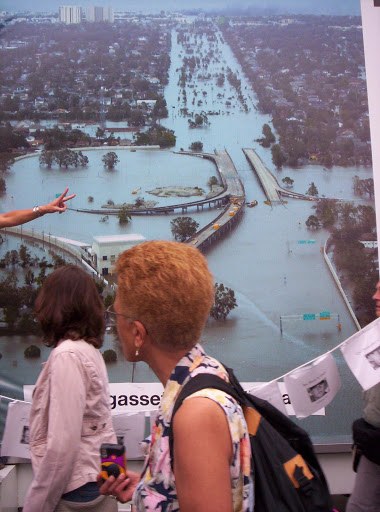 spectrum there was the Tenth Annual Katrina March and Second-line, the most serious political event of the day, which sponsored speeches and performances at the site of the levee break in the devastated and still depopulated Lower Ninth Ward. It had a significant turnout, though certainly under a thousand participants.
At the other extreme was the Krewe of O.A.K, which practiced a kind of “commemorating by not commemorating†in its annual Mid-Summer Mardi Gras parade and celebration. O.A.K. stands for “Outrageous and Kinky,†in addition to “Oak St.,†its starting point at the Maple Leaf Bar. The parade, noted for its wild costumes and zany ambience, attracted perhaps 10,000 to this Carrollton neighborhood event. According to the Times-Picayune, the Krewe chose the theme “Tie Dye Me Up,â€Â to evoke the famous “Summer of Love,†and “bring good vibes to this annual parade.†It added: “No mention of the ‘K’ word, please.†(more…)

 guest at the Greek table.
 and some European nations would like to see the bombs withdrawn from Europe.
 massively impact health and life everywhere on Earth. How can we respond to something so overwhelming, so huge, so threatening that there is nowhere to hide except in denial? We’ve been trying that for almost 70 years. The numbers of weapons are down, their accuracy and lethality are up. It is time to try something new.
 my children’s future. Yet our government continues to manufacture nuclear materials and unsafely store radioactive waste in clear violation of the public trust.Nowhere is this more visible than at the Hanford Nuclear Reservation, the most radioactively contaminated site in the western hemisphere, where we now know radioactive sludge is leaking badly from at least six underground tanks. While Hanford is technically in Washington State, the management of this catastrophe is vitally important to the rest of the nation — indeed, the biosphere. Unfortunately, environmental disasters do not stop at city, state, or national borders.
  I am writing this letter at 3:53 pm on January 12, 2013.  Three years ago today, Port au Prince was bustling with activity as people spilled into the streets from work and school.  Mothers returned home after a long day of working under the hot sun, fathers greeted their children with tired eyes, neighbors shared warm handshakes and laughed away the day’s challenges.  One hour later the city collapsed and over 300,000 of these mothers, fathers, children and neighbors were lost in an instant. Last night at the stroke of midnight the hills around our house in Port au Prince exploded with voices from the thousands of people attending an all night service in honor of those lost in the earthquake 3 years ago today. What struck me most deeply, was not the despair in the voices, it was the sound of ecstasy, the sound of resilience it was the sound of life. It was as though at the same time as people were mourning their loved ones, they were giving thanks for those who were spared, the were celebrating their strength in surviving, not only the earthquake, but the 3 years of struggle that have followed.
