May 07, 2012
By: NCVeditor
Category: Culture, Ecology, Family, Windy Cooler
Falling into the Poles…
by Windy Cooler
The color and quality of the light here is, I don’t know, dense. I always feel like I am being pushed into myself, quieting, sinking, falling  through what is me and through the floor of the Earth when I walk alone here, visiting what seem like the ruins of the civilization I was part of eons ago, like the last survivor of Pompeii, when it was I who left. This is Montgomery, Alabama.
This is where I was a teenager and where I spent my early years as a mother, the place where I worked as a projectionist in a neighborhood theater, a non-profit one screen art house, called The Capri. Alabama is where my mother’s family has lived since before the American Civil War, in a small, ever flooding town called Elba, just north of Mobile. I am hardly a survivor as I burn and push through. I used to fancy myself one, feeling the need to keep on breathing through poverty and constant shaming, breathing and birthing a creature I could be proud of. The irony though is that surviving made me ashamed. And birthing is falling too. Read the rest of this entry →
Comments (3)
May 04, 2012
By: NCVeditor
Category: Culture, Family, Politics, Victoria Law
Toward the Quiet Creation of an All-Ages Revolution
by Victoria Law
It is Sunday afternoon. My daughter and I are at home. I am on my (borrowed) laptop in the kitchen, revising chapter forwards for Don’t Leave Your Friends Behind, an anthology on how to support parents and children in social justice movements that I am co- editing with the amazing “grandma of mama zines†China Martens. Garlic bubbles away into broth on the stove, filling the kitchen with warmth (and a very savory fragrance).
In the other room, my 11-year-old daughter is on her dad’s computer and on the phone at the same time. She is on a conference call/computer chat with the folks planning childcare to talk about the Big Kids’ track for this year’s Allied Media Conference. I am, thankfully, not part of the efforts to coordinate either the Kids’ Track or the Big Kids’ Track, but I do wonder how the conversation is going. I can hear my daughter’s fingers strike the keyboard as she enters her ideas into their group chatbox, but I hear her voice much less often.
While puzzling over how to succinctly sum up the gist of each chapter, fittingly on how movements and communities and individuals have supported the children and caregivers in their midst, my thoughts drift back to the event I attended last night: Angela Davis’s talk about prison abolition and a conversation between her and Mumia Abu-Jamal, who was allowed to call in to the event for an all-too-short fifteen minutes. Read the rest of this entry →
Comments (4)
May 03, 2012
By: NCVeditor
Category: Economy, Harry Targ, Politics
How Do We Build Our Movements?
by Harry TargÂ
Over the last fourteen months we have observed Arab Spring, the Wisconsin uprising, labor ferment throughout the American Heartland, and the formation of Dream Coalitions. In addition Occupy Movements last fall spread like wild fire all across the country  and with the arrival of spring are resuming. Most recently anti-racist mobilizations have occurred in response to the execution of Troy Davis and the murder of Trayvon Martin.
In response, socialist and progressive organizations, single issue groups, political party activists, and visible pundits have called for or organized rallies, marches, conferences and other mobilizations in Washington D.C., Chicago, New York and elsewhere. Grassroots activists, motivated by a passion for change, and sometimes a sense of desperation, are on the move. While these are exciting times for progressives and lifetime organizers, it makes sense to take a deep breath, reflect on the concrete situations of struggle we face, and to ask ourselves how best to channel (and preserve) our energies and resources. Read the rest of this entry →
Comments (3)
May 02, 2012
By: NCVeditor
Category: Culture, Current Events, Politics, Robert C. Koehler
Overcoming the State of Fear Through Restorative Practices
by Robert C. Koehler
This was the headline: “Zimmerman, Martin’s parents to face off in court.â€
 The words, of course, merely summed up a moment in the news cycle last week. We, the news-consuming public, were primed — by CBS, but it could have been any mainstream outlet — for a tidbit of potential drama the next day in the hottest murder trial around right now. But in the process, we were also silently reminded, yet again, that everything is spectacle. At the level at which we call ourselves a nation, nothing is serious, not even matters of life and death.
There’s something so painful about all this — painful beyond the horror of the crime itself, or the national murder rate. The 24-7 media trivialize the stakes and gleefully report the “courtroom drama†as a sporting event; but even more distressingly, the legal bureaucracy swings into motion without the least awareness of any value beyond its own procedures. It all happens with a certainty of purpose that generates the illusion that things are under control and social order prevails. But none of this has anything to do with what social order actually requires when harm has occurred, which is . . . healing. Read the rest of this entry →
Comments (3)
May 01, 2012
By: NCVeditor
Category: Diane Lefer, Economy, Family, Politics
Working Smarter to Save Workers’ Lives
by Diane Lefer
According to US Secretary of Labor Hilda Solis, more people die in the American workplace in a single year than have been lost in nine years of war in Iraq. “Each day in America, twelve people go to work and never go home,†she told the audience at the Action 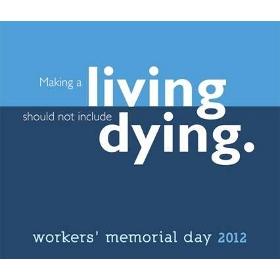 Summit for Worker Safety and Health held at East Los Angeles Community College on April 26, one of many events leading up to Workers Memorial Day, April 28, an annual date of remembrance for those killed, injured, or sickened on the job.
MarÃa Elena Durazo, Executive-Secretary-Treasurer of the Los Angeles County Federation of Labor, AFL-CIO, reported there were 500 work-related deaths in 2011 in California and “Workers are still being fired for speaking out in order to avoid death.â€
This loss of life and countless serious injuries, continue to occur although the Occupational Safety and Health Act (OSHA), intended to protect workers, was signed by Richard Nixon 41 years ago. Read the rest of this entry →
Comments (3)
April 30, 2012
By: NCVeditor
Category: Ecology, Economy, Jay Walljasper, Politics
Implementing Strong Pro-Commons Policies
by Jay Walljasper
The Tea Party, libertarians and other so-called conservatives devoted to slashing all government spending not related to the military, prisons and highways have an easy answer when asked what happens to people whose lives and livelihoods depend on public  programs. They point to volunteerism — the tradition of people taking care of each other which has sustained human civilization for millennia.
It’s a compelling idea, which evokes the spirit of the commons (the growing movement to protect and expand the whole sphere of cultural and economic assets belonging to all of us together). Volunteers working largely outside the realm of government — neighborhood organizations, fire brigades, blood banks and other civic initiatives — are obvious examples of commons-based sharing and caring.
So that means Ron Paul, Michelle Bachmann and Mitt Romney qualify as commoners (people working to improve the state of our commons)? Even with their adamant skepticism about Medicare, environmental regulations and campaign finance limits? Read the rest of this entry →
Comments (3)
April 27, 2012
By: NCVeditor
Category: Culture, Jerry Elmer, Politics
The Haymarket Affair and the Origins of May Day
by Jerry ElmerÂ
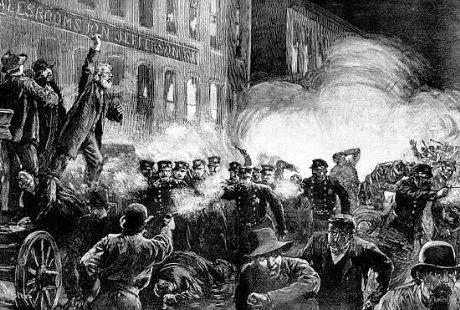
May 1st is May Day, the international workers’ holiday honoring the labor movement. May Day is celebrated in at least 80 countries worldwide, from Argentina to Vietnam, but not in the United States. Here, our “Labor Day†was carefully put into September – by  President Grover Cleveland in 1894 – specifically so that we would not observe May Day, with all of its radical roots in syndicalist labor history. This is deeply ironic, for the event that gave rise to May Day observances the world over occurred right here in the United States: the bombing at Haymarket Square, Chicago, on May 4, 1886, during a labor rally.
The context for the Haymarket riot in 1886 was the movement for the eight-hour work day. The movement had started at least as early as 1877, when the Workingmen’s Party in Chicago called a general strike beginning July 25 in support of the eight-hour movement. The next day, on July 26, 1877, thousands of strikers were attacked and beaten into submission by police and U.S. Army infantrymen with fixed bayonets. Thirty strikers, including a number of children, were murdered by the police and federal troops. During that strike, typesetter Albert Parsons, later one of the Haymarket martyrs, was fired from his job because of a speech he had given during the strike. The bloody suppression of the 1877 strike caused another of the Haymarket martyrs, upholsterer August Spies, to join an armed worker’s self-defense organization. Read the rest of this entry →
Comments (3)
 through what is me and through the floor of the Earth when I walk alone here, visiting what seem like the ruins of the civilization I was part of eons ago, like the last survivor of Pompeii, when it was I who left. This is Montgomery, Alabama.