New Clear Vision


constructive commentary for the chronically farsighted


Archive for the ‘Politics’

Welcome to America

April 12, 2012 By: NCVeditor Category: Community, Culture, Devon G. Pena, Politics

Connecting Indigenous Autonomy and Immigration

by Devon G. Peña

A recent poster prepared by Michigan State University assistant professor and artist,  Dylan Miner, asks that we “decolonize immigration through indigenous and migrant solidarity.” On seeing this beautiful artwork, I was compelled to once again reflect on the perverse nature of U.S. immigration law. The struggle to decolonize immigration law and policy challenges an unjust, racialized, and convoluted history, and reveals the highly problematic qualities of modern state sovereignty in the policing of borders across a region that remains a resurgent indigenous homeland.

I recall the sorrow and discrimination provoked by Arizona’s SB 1070 when numerous Native American elders were suspected of being “illegals” because they could not produce birth certificates to prove otherwise. Imagine that: natives seen as “illegals” and deemed subject to deportation under the state of exception for failure to provide documentation of their right to live on their native land. A deeper injustice and more banal contradiction is not possible, since the authors of 1070 arrived in Arizona but a mere night ago and are now dictating the legal status of peoples inhabiting the bioregion for tens of thousands of years. (more…)
It’s Kicking Off Everywhere

April 10, 2012 By: NCVeditor Category: Current Events, Economy, Guest Author, Politics

2011’s Global Protests Didn’t Come Out of Nowhere…

by Anya Barry

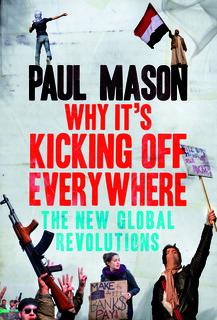
It was not sheer coincidence, journalist Paul Mason explains in Why It’s Kicking Off Everywhere: The New Global Revolutions, that drove people from places as varied as Egypt, Greece, Britain, New York City, and Wisconsin to stand up and speak out against injustice in 2011. Rather, a cascading international financial crisis brought the disconnect between governments and citizens into sharp relief, which ultimately resulted in a massive series of protests in all corners of the map.

Although many reporters have written off the protesters as radicals without any real vision, Mason gets down in the dirt with the people issuing the outcry, serving as an articulate and smart mouthpiece to help the rest of society understand the importance of these ongoing movements throughout the world. As a way of explaining the inspiration behind movements like Occupy Wall Street, Mason quotes Franco Berardi, a contemporary writer who states, “There is only one way to awake the lover that is hidden in our paralyzed, frightened and frail virtualized bodies. There is only one way to awake the human being that is hidden in the miserable daily life of the softwarists: take to the streets and fight.” (more…)

Taking a Stand

April 09, 2012 By: NCVeditor Category: Ecology, Jennifer Browdy, Politics

What Will It Take to Accomplish Real Change?

by Jennifer Browdy de Hernandez

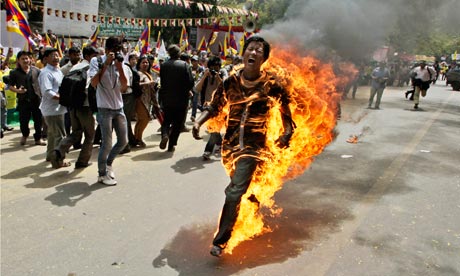
Environmental activist Tim DeChristopher and Jamphel Yeshi, the young Tibetan monk who recently set himself on fire, are more alike than might first meet the eye.

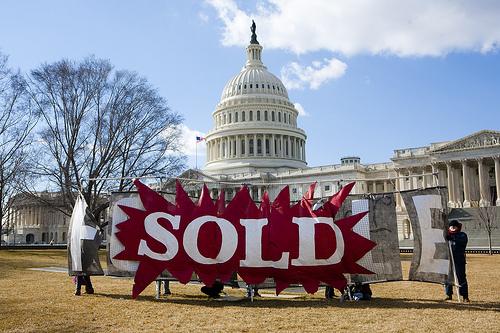
DeChristopher, one of the founders of the group Peaceful Uprising, took direct action to disrupt the sale of wilderness to mining companies in a closed Federal auction.  He ended up in prison, but he also did a tremendous amount to raise public awareness about the issue of land sales to corporate industry, and inspired the PeaceUp folks to greater activism.

Jamphel Yeshi also took a dramatic personal action at huge cost to himself — he lost not just his liberty, but his life. He and the 30 other monks who have taken this drastic step in the past have succeeded in letting the world know how deeply the Tibetan people are suffering under Chinese repression, and how passionately they yearn for autonomy to practice their religion and preserve their culture. (more…)

Word Games

April 06, 2012 By: NCVeditor Category: Culture, Matt Meyer, Politics

Removing ‘War’ from the History Books?

by Matt Meyer

As any good teacher should do on weekends, I have been preparing for my New York State Regents-based course in United States History. In light of last week’s revelations that the New York City Department of Education (the largest such public bastion of knowledge in the country) has sent out a list of proposed words to be avoided in the creation of tests, the scope of my new curriculum might end up looking something like this:

After the Revolutionary Skirmish of 1776, there were great debates about the founding principles of the new nation. As the thirteen colonies became thirteen states, questions of representation became especially heated when Southern state leaders asserted the need for the continuation of freedom-less-ness for people of African descent. Eventually, a Civil Hostility took place, which saw an end to vassalage. This helped pave the way for the US to become an even more respected power, but it did not truly become an international force until involvement in World Big Fight One. (more…)

Sonic Youth

April 02, 2012 By: NCVeditor Category: Culture, David Smith-Ferri, Politics

Above the Drone of War, Voices for Peace Rise in Afghanistan

by David Smith-Ferri

In 1876, at the so-called Battle of the Little Bighorn when U.S. Cavalry regiments attacked an Indian village along the Little Bighorn River in Wyoming, the first casualty was a ten-year old Lakota Sioux boy named Deeds. Unaware that U.S. troops were nearby planning an attack, he and his father were combing a hillside looking for a lost pony when U.S. troops encountered and killed him. The next casualties were six Lakota women and four children, who were murdered while in a field gathering wild radish bulbs, one of the many indigenous plants that Native people depended on for their livelihood, and hardly a threatening activity.

I think of these events today because of the recent killings of Afghan civilians, not only the 17 women and children killed in villages outside Kandahar, but also two recent and less publicized atrocities resulting from NATO airstrikes that killed civilians in Kapisa Province, including eight Afghan boys who were tending their sheep. Sheepherding, of course, is an activity as integral to their livelihood as gathering indigenous plants was to Lakota people. (more…)

Joel Olson, 1967-2012

March 30, 2012 By: NCVeditor Category: Family, Joel Olson, Politics

Mourning the Loss of a Colleague, Comrade, and Friend

We are deeply saddened by the loss of esteemed activist, writer, scholar, and NCV Contributor Joel Olson, who passed away while on sabbatical in Europe.

Joel was Associate Professor in the Department of Politics and International Affairs at Northern Arizona University in Flagstaff, Arizona, where he specialized in political theory. A noted expert on racial politics and extremist ideologies, he was the author of The Abolition of White Democracy (University of Minnesota Press, 2004) as well as numerous articles and reviews. Joel was working on a second book, entitled American Zealot: Fanaticism and Democracy in the United States, at the time of his death.

During the 1990s Joel was involved with the Love and Rage Revolutionary Anarchist Federation and later went on to form Bring the Ruckus! He was a well-known figure in the anti-racist and pro-immigrant movements in Arizona, working with grassroots groups including Copwatch and the Repeal Coalition. (more…)

Rethinking Elections

March 30, 2012 By: NCVeditor Category: Culture, David Swanson, Politics

Moving from ‘Lesser Evil’ to ‘Greater Good’

by David Swanson

I think two opposing trends have been at work in U.S. history. One is that of allowing more people to vote. This is an ongoing struggle, of course, but in some significant sense we’ve allowed poor people and women and non-white people and young people to vote. The other trend, which has really developed more recently, is that we’ve made voting less and less meaningful. Of course it was never as meaningful as many people imagine. But we’ve legalized bribery, we’ve banished third parties and independents, we’ve gerrymandered most Congressional districts into meaningless general elections and left one party or the other to exercise great influence over any primary. Rarely does any incumbent lose, and rarely does a candidate without the most money win. Extremely rare is a winning candidate who lacks some major financial backing. Rarer still is a candidate who even promises to pursue majority positions on most major issues, or who convincingly commits to following the will of the public over the will of the party. Most Congress members are pawns in a government with two partisan voices, not the voices of 535 individual representatives and senators. Rare, as well, is any possibility in a close primary or general election of verifying the accuracy of a vote count. (more…)

  • Welcome to NCV

    A (relatively) NEW blog filled with (generally) CLEAR intentions and a (positive) VISION for the future.
  • Latest Posts

  • GONE, NOT FORGOTTEN

    Since launching in 2010, we featured many inspiring writers on cutting-edge issues. In times of escalating crises, we sought to remain proactive rather than perpetually reactive, to not give more power to those who would co-opt the agenda, and to try turning visions in practice. We can critique what is and offer insights into what could be, without becoming embittered in the process. We weren't partisan, but we'll always stand on the side of those who desire peace with justice. We're not posting anymore new content as of 2017, but our archive will remain up and you can still find us on social media. We'll see you in the interwebs...
  • New! Thematic ‘Zines

  • Tags

  • Archives

  • NCV Bookmarks

    Peace Ecology
  • Green by DreamHost

    carbon neutral * renewable energy
    Green Web Hosting! This site hosted by DreamHost.