Bon Appétit
Food Service Workers Without Healthcare
by Pat LaMarche
This week — in the midst of the government shut down over the Affordable Care Act — the New York Times ran a number of graphs and tables that explained where the poor and those lacking health insurance live and work.
 Now if you don’t like math or if you intend to eat out tonight, you might not want to read any further.
See, it turns out that cooks and waiters/waitresses make up 33% of the uninsured. That doesn’t mean that 33% of them are uninsured, it means that they make up 33% of the 48 million uninsured in the nation. Cashiers are another 19%. That means that more than half the uninsured in our nation are those people that probably just handled your food.
So now let’s draw on that high school math you learned. Remember studying exponential growth and graphing a resulting number based on what we multiplied and added to a beginning number? We used the X and Y axes to represent these points. If your head’s starting to hurt, stop thinking of numbers and picture a beautiful sky with a sliver of a moon. That moon shape is kind of what this graph will look like. It’s starts out slowly moving to the right and then sweeps upward rather quickly. (more…)
 River watershed north of Seattle, does count with a prosperous fruit and vegetable agricultural industry. Of course, the industry relies on mostly migrant families for farm labor. This is especially the case during harvest work and strawberry crops present an opportunity for workers to seize the current condition of ‘labor scarcity’ and high demand for skilled pickers during harvest time to organize for their workplace rights. And that is exactly what has happened in the State of Washington, and not in the Yakima or Wenatchee valleys but on the western side of the Cascades where peri-urban farming is increasingly big business.
  expanding on such models might begin to right the wrongs of an incredibly unequal society that is growing even more unequal by the day.
 immigrants, most of them Mexicans who have joined some of the older Chicana/o families with roots in the area dating back 3-4 generations.
 “The scope of injuries,†Jim Yardley writes in theÂ
“The scope of injuries,†Jim Yardley writes in the 
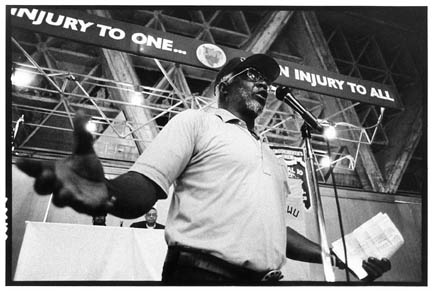 Leo Robinson came into the International Longshore and Warehouse Union because of a deal made by Harry Bridges and the Communists who led the waterfront strike of 1934. That strike metastasized and became a three-day general strike after cops shot and killed three strikers. It was the birth of the ILWU, and changed the political history of the west coast.
