Wealth vs. Money
Resisting the Forces of Privatization and Commodification
by Robert C. Koehler
“There is no patent. Could you patent the sun?â€
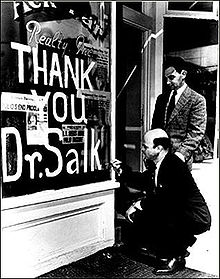 The words are those of Jonas Salk, developer of the polio vaccine, speaking to Edward R. Murrow in 1955, as quoted recently in an essay by Paul Buchheit. What was he thinking? Six decades later, the words have such a counter-resonance with prevailing thought. They exude an old-fashioned humility and innocence, like . . . striking it rich isn’t necessarily the ultimate point of life?
I read these words and sense so much spilled wisdom in them, so much wasted hope. The world we’ve created is governed these days by two unquestioned principles: commodify and dominate. And it’s chewing up the resources that used to belong to every occupant of the planet.
“Eighty people hold the same amount of wealth as the world’s 3.6 billion poorest people, according to an analysis just released from Oxfam,â€Â Mona Chalabi wrote in January at FiveThirtyEight.com. “The report from the global anti-poverty organization finds that since 2009, the wealth of those 80 richest has doubled in nominal terms — while the wealth of the poorest 50 percent of the world’s population has fallen.†(more…)
 The answers provided by the evening’s presenters — all women at various stages of their lives — were various, but there was a common theme: mothers make families, mothers make relationships, mothers make community.
 Move over, We Buy Ugly Houses.com and Jackass Presents Bad Grandpa. Here was religious faith on a billboard, refuting non-belief in letters three feet high. I was visiting Los Angeles, driving with a friend along La Cienega Boulevard, when this king-size ad for religious certainty smacked us in the eye.
 and around the globe came into sharp focus. Though the remarks of Zambian Vice President Guy Scott — that South Africa is disliked among Africans for “the same reason that Latin Americans dislike the United States†— were uncharacteristically undiplomatic, many South Africans were forced to admit that Scott’s impression is increasingly on the mark. With South African National Defense Force (SANDF) troops deployed in the Democratic Republic of the Congo, in the Central African Republic, in Liberia, Ethiopia, Mozambique, the Sudan, Burundi and elsewhere, it is not surprising that some analysts — such as University KwaZulu-Natal’s Patrick Bond — call South Africa’s current position nothing short of “sub-imperialist.â€
 My colleague — who is a highly respected activist in New Mexico — declared that the movement is largely dead. The EJM, she explained, is a casualty of defunding and especially the loss of financial support for the various national and regional networks. There is no national movement, she argued, because the funders abandoned their commitment to the EJ organizations.
 any combination of those.
 as I have to any other relationship. I’m not proud of it. But maybe I’m getting better at putting relationships with people and my environment ahead of money.
