More than a Trend
Urban Agriculture in Mexico City: Healthy and Necessary
by Devon G. Peña
The Colhua Mexica (Aztec) twin island cities of Tenochtitlan and Tlatelolco were filled with urban farms, home kitchen gardens, fish-stocked ponds, and aviaries. Two large lakes south of the cities were filled with highly productive floating gardens known 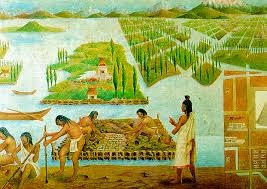 aschinampas. These ancient Mesoamerican city-states were basically food self-sufficient. The conquest destroyed most of these cultural ecological landscapes and built Mexico City with the rubble of demolished temples, schools, colleges, homes, and other buildings. Mexico City has never been able to reproduce this ideal condition of food self-sufficiency and instead basically sucks the energy out of the Mexican countryside and — ever since NAFTA — from fresh produce and processed food imported or manufactured with ingredients from the U.S. and other countries. (more…)
 the problems of inequality caused by the capitalist economy and then focus on our city, Chicago, as a means to understand our places in the economy as working class people of color.  To learn about ourselves in Chicago I use a text written by the Chicago Grassroots Curriculum Taskforce.  The book, Urban Renewal or Urban Removal? is volume one of a planned eight.  Authors of the text include activists, teachers, parents, long-time residents and professors.  It is a grassroots bunch of dedicated organic intellectuals.Â
the problems of inequality caused by the capitalist economy and then focus on our city, Chicago, as a means to understand our places in the economy as working class people of color.  To learn about ourselves in Chicago I use a text written by the Chicago Grassroots Curriculum Taskforce.  The book, Urban Renewal or Urban Removal? is volume one of a planned eight.  Authors of the text include activists, teachers, parents, long-time residents and professors.  It is a grassroots bunch of dedicated organic intellectuals.  self-rule or seed democracy. They are also committed to bija satyagraha or non-cooperation with the powerful corporate seed machines and unjust laws and legal structures that benefit transnational corporations at the expense of the planet.  This summer at the Outdoor CommUnity Classroom at the Peace Garden, gardeners discussed international movements for food sovereignty and food autonomy, especially as detailed by Vandana Shiva in her numerous works and how this related to the their situations in the U.S. inner city.
  let’s not forget the lowly commons all around that enrich our lives. Things like sidewalks, playgrounds, community gardens, murals, neighborhood hangouts, and vacant lots. Especially vacant lots.
 the central cause of the Arab Spring of 2011.  In Syria, the drought of 2006-2011 left 75% of farmers from the northeast and south with total crop failure. He writes that: “According to the UN, 800,000 Syrians had their livelihoods totally wiped out.  One researcher notes that ‘the single factor that triggers riots around the world is food.’â€Â  In 2007, 48 countries experienced food riots.
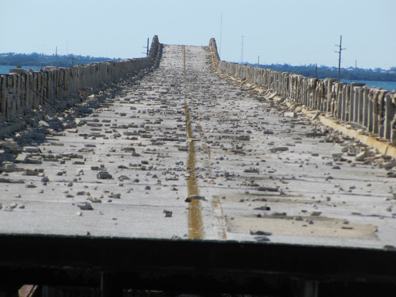 hippies). When a grassroots wing of the environmental movement went after road building and pavement (tarmac) two decades ago, it was quite fringy for mainstream enviros. Then when we went after plastics a decade ago, this too was considered “out there,” and kept low on the list of concerns for the average campaigner.