Faux Real
What’s in Your Worldview?
by Randall Amster
We had to know this was coming. It was always here, but now it can be seen more clearly through the unvarnished lens of protofascism. Retrenchment and revanchism arrive with a new pitchman, selling rollbacks disguised as opportunities and promising to reclaim that which has been lost after  decades of social progress and cultural liberalization. This isn’t a “new normal†but rather an old one reemerging, and the only sort of normality it represents is that which is perversely defined by a type of mass insanity.
Things have been heading in this direction for a long time now, but the pace obviously has accelerated in the digital age. The lamentations about the demise of truth and the advent of bogus “news†are legion, as are the observations about the omnipresence of technology and the implications thereof. But all this hasn’t happened to us — it has veritably been demanded. Obscured by the handwringing and finger-pointing is the deeper reality of a culture obsessed with on-demand indulgences, no matter the cost. (more…)
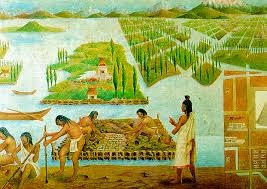 aschinampas. These ancient Mesoamerican city-states were basically food self-sufficient. The conquest destroyed most of these cultural ecological landscapes and built Mexico City with the rubble of demolished temples, schools, colleges, homes, and other buildings. Mexico City has never been able to reproduce this ideal condition of food self-sufficiency and instead basically sucks the energy out of the Mexican countryside and — ever since NAFTA — from fresh produce and processed food imported or manufactured with ingredients from the U.S. and other countries.
  When I am not teaching at the University of Washington, I work on a 200-acre flood-irrigated farm that also serves as the home for my family’s foundation, The Acequia Institute. We run the farm as an almunyah, which is essentially a private, non-profit “agricultural experiment stationâ€. We serveÂ
When I am not teaching at the University of Washington, I work on a 200-acre flood-irrigated farm that also serves as the home for my family’s foundation, The Acequia Institute. We run the farm as an almunyah, which is essentially a private, non-profit “agricultural experiment stationâ€. We serve  self-rule or seed democracy. They are also committed to bija satyagraha or non-cooperation with the powerful corporate seed machines and unjust laws and legal structures that benefit transnational corporations at the expense of the planet.  This summer at the Outdoor CommUnity Classroom at the Peace Garden, gardeners discussed international movements for food sovereignty and food autonomy, especially as detailed by Vandana Shiva in her numerous works and how this related to the their situations in the U.S. inner city.
  There must have been at least forty federal bureaucrats around a huge wooden table in a large conference room. I asked them how many peasants they or the United Nations had invited to address the 1979 Agrarian Reform and Rural Development Conference in Rome. After all, who knows more about the pain of the peasants than peasants themselves?
 Of course, I had heard of ecology before joining EPA in 1979. I studied zoology as an undergraduate, so I was familiar with ecology and its theoretical focus on connections and processes. They underpinned the natural world.
 labor with great success. We’ve become dependent on carbon fuels. Coal and oil companies have spent millions to make sure that it stays that way.Â
labor with great success. We’ve become dependent on carbon fuels. Coal and oil companies have spent millions to make sure that it stays that way. 
