Revolutions Happen
On the Crisis of Neoliberalism and the Alternative of the Common
by Devon G. Peña
Revolutions happen. One has already started though many people are yet to recognize it. But they may already be participating in it and helping to bring alterNative[1] futures forward. The resurgence of the common is the revolution quietly unfolding around us  and through each of our relations and actions.
Here, I explore the enactment of a new social revolution the multitude (a.k.a. the 99%) is creating to ‘sublate’ (aufheben)[2] neoliberal capitalism in the spaces of direct material production and bio-politics, qua reproduction. The resurgence of the common is the underlying force driving a largely subaltern and protean process of revolutionary change.
It is through the agency of collaborative networks and their spaces of autonomy that we are disrupting the empire of the commodity form and threatening the stability and long-term survival of the neoliberal state of economic exception (Negri 2008). (more…)
 self-rule or seed democracy. They are also committed to bija satyagraha or non-cooperation with the powerful corporate seed machines and unjust laws and legal structures that benefit transnational corporations at the expense of the planet.  This summer at the Outdoor CommUnity Classroom at the Peace Garden, gardeners discussed international movements for food sovereignty and food autonomy, especially as detailed by Vandana Shiva in her numerous works and how this related to the their situations in the U.S. inner city.
  In it, Buffett takes to task what he calls “the Charitable-Industrial Complex,†the philanthropic crowd who piously seek to save the world, as long as the R.O.I. is sufficiently rosy and the status quo is not upset.
 ending industrial-patriarchal-capitalist imperialism.
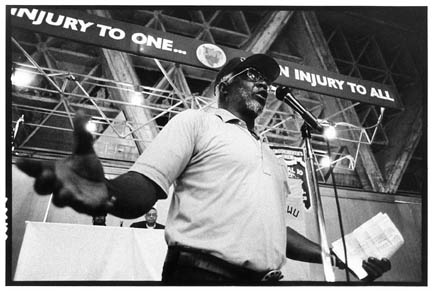 Leo Robinson came into the International Longshore and Warehouse Union because of a deal made by Harry Bridges and the Communists who led the waterfront strike of 1934. That strike metastasized and became a three-day general strike after cops shot and killed three strikers. It was the birth of the ILWU, and changed the political history of the west coast.
 To me, the Twinkie tasted like Elmer’s Glue with sugar encased in a squishy sponge or pound cake. It was too chalky and gooey all at once. Hmm. Must have missed out on the Leave it to Beaver upbringing required, I imagine, to love a quasi-food like that.