April 30, 2014
By: NCVeditor
Category: Ecology, Economy, Robert C. Koehler
Can We Turn the Tide While There’s Still Time?
by Robert C. Koehler
“We cannot afford to lose another decade.â€
 My God. There’s more darkness in this quote than the New York Times intended. I winced when I read these words of Ottmar Edenhofer, co-chairman of the committee that wrote the latest United Nations Intergovernmental Panel on Climate Change IPCC report, which the Times quoted in a recent editorial headlined “Running Out of Time.â€
Suddenly, ten years felt vital, alive with possibility. Edenhofer wasn’t referring to some abstract decade embedded in the history of the human race, or the history of the planet, but ten years gouged out of our own lifetimes and certainly out of our children’s lifetimes. We can’t afford to lose … ten years of breath and heartbeat. Read the rest of this entry →
Comments Off on Losing Another Decade
April 25, 2014
By: NCVeditor
Category: Community, Devon G. Pena, Ecology, Economy
On the Crisis of Neoliberalism and the Alternative of the Common
by Devon G. Peña
Revolutions happen. One has already started though many people are yet to recognize it. But they may already be participating in it and helping to bring alterNative[1] futures forward. The resurgence of the common is the revolution quietly unfolding around us  and through each of our relations and actions.
Here, I explore the enactment of a new social revolution the multitude (a.k.a. the 99%) is creating to ‘sublate’ (aufheben)[2] neoliberal capitalism in the spaces of direct material production and bio-politics, qua reproduction. The resurgence of the common is the underlying force driving a largely subaltern and protean process of revolutionary change.
It is through the agency of collaborative networks and their spaces of autonomy that we are disrupting the empire of the commodity form and threatening the stability and long-term survival of the neoliberal state of economic exception (Negri 2008). Read the rest of this entry →
Comments Off on Revolutions Happen
April 23, 2014
By: NCVeditor
Category: Family, Missy Beattie
Thoughts on ‘Authentic Carbon Trading’
by Missy Beattie
Recently, I read an article about the aging population, specifically, those who have Alzheimer’s and other forms of dementia, and the burden placed on families, society, and health care. As always, I looked at reader reactions. A man said he’s saving for the  likelihood of an Alzheimer’s diagnosis, long-term care in a facility, so his children won’t have to bear the responsibility. I agree with the person who said she’d take her own life if diagnosed with a mind-robbing, progressive condition. You know, go while the going is good.
We, the Sisterhood, Laura, Erma, and I, discuss end times. Our own.
I have it on the best authority that I am not depressed. Read the rest of this entry →
Comments Off on Paying It Forward
April 21, 2014
By: NCVeditor
Category: Ecology, Robert C. Koehler
Living in Partnership with Mother Earth
by Robert C. Koehler
Okay, humankind, it’s time to grow up, and I see a good way to start: Change the wording of Genesis 1:26. Change one word.
 I recently quoted that Bible verse in a column about the increasing velocity of climate change: “And God said . . . let them have dominion over the fish of the sea, and over the fowl of the air,†etc. Dominion! Nature belongs to us, to suck dry and toss away. And thus we moved out of the circle of life and became its conquerors, an attitude at the core of the Agricultural Revolution and the rise of civilization. The momentum of this attitude is still driving us. We don’t know how to stop, even though most people now grasp that we’re wrecking the environmental commons that sustains life. Read the rest of this entry →
Comments Off on Growing Up
April 18, 2014
By: NCVeditor
Category: David Swanson, Economy, Politics
War Brings Peace and Prosperity, New Book Claims
by David Swanson
Ian Morris has stuck his dog’s ear in his mouth, snapped a selfie, and proclaimed “Man Bites Dog.” His new book War: What Is It Good For? Conflict and Progress of Civilization from Primates to Robots is intended to prove that war is good for children and 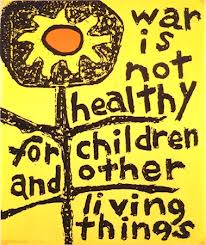 other living things. It actually proves that defenders of war are growing desperate for arguments.
Morris maintains that the only way to make peace is to make large societies, and the only way to make large societies is through war. Ultimately, he believes, the only way to protect peace is through a single global policeman. Once you’ve made peace, he believes, prosperity follows. And from that prosperity flows happiness. Therefore, war creates happiness. But the one thing you must never stop engaging in if you hope to have peace, prosperity, and joy is — you guessed it — war.
This thesis becomes an excuse for hundreds of pages of a sort of Monty Python history of the technologies of war, not to mention the evolution of chimpanzees, and various even less relevant excursions. These pages are packed with bad history and guesswork, and I’m greatly tempted to get caught up in the details. But none of it has much impact on the book’s conclusions.  All of Morris’s history, accurate and otherwise, is put to mythological use. He’s telling a simplistic story about where safety and happiness originated, and advocating highly destructive misery-inducing behavior as a result. Read the rest of this entry →
Comments Off on What Is It Good For?
April 14, 2014
By: NCVeditor
Category: Community, Culture, Devon G. Pena, Politics
Student Perspectives on the Necessity of Ethnic Studies
moderated by Devon G. Peña
{Moderator’s Note: We are presenting selected blog posts written by students in a winter quarter (2014) course, “Introduction to Chicana/o Studies†(CHSTU 101 that just completed meetings at the University of Washington. My graduate assistant Victor  RodrÃguez pre-selected the blogs and I did final copy-editing and formatting but the ideas and representations made here were entirely the result of the eight weeks of group research activities conducted by these young students. When we ask first- and second-year students to perform at this higher level of independent inquiry and critical thinking by asking them to engage in collaborative research and writing, we are actually revealing their capacity for a genuine love of learning that introduces them to diverse methods of inquiry and idea testing. When this happens, all is well in the classroom and we can feel a bit more confident that they will be better prepared to engage the prospects for democracy toward more just, equitable, and sustainable future. Read the rest of this entry →
Comments Off on Destabilizing Power
April 07, 2014
By: NCVeditor
Category: Community, Politics, Robert C. Koehler
High-Stakes Testing Undermines the Essence of Teaching
by Robert C. Koehler
A mind is a terrible thing to test, especially a child’s mind — if, in so doing, you reduce it to a number and proceed to worship that number, ignoring the extraordinary complexity and near-infinite potential of what you have just tested.
 “In every work of genius we recognize our own rejected thoughts: they come back to us with a certain alienated majesty.â€Â What if?
What if the American education bureaucracy understood these words of Ralph Waldo Emerson and honored the latent genius of every student? What if it funded teachers and schools with as much enthusiasm as it did corporate vendors? What if, in some official way, we loved kids and their potential more than the job slots we envisioned for them and judged them only in relationship to their realization of that potential? What if standardized testing, especially the obsessive, punitive form that has evolved in this country, went the way of the dunce cap and the stool in the corner? Read the rest of this entry →
Comment (1)

