September 26, 2013
By: NCVeditor
Category: Culture, Ecology, Evaggelos Vallianatos
Can It Be an Antidote to Our Toxic Age?
by Evaggelos Vallianatos
One of the discoveries I made during my 25-year tenure at the U.S. Environmental Protection Agency was ecology.
 Of course, I had heard of ecology before joining EPA in 1979. I studied zoology as an undergraduate, so I was familiar with ecology and its theoretical focus on connections and processes. They underpinned the natural world.
But nothing had prepared me for the political ecology of EPA. I came to know a few ecologists and, more than that, I read dozens of their memos.
It was then I realized the harmful effects of pesticides — and the limits of ecology in America. Read the rest of this entry →
Comment (1)
September 25, 2013
By: NCVeditor
Category: Ecology, Guest Author, Politics
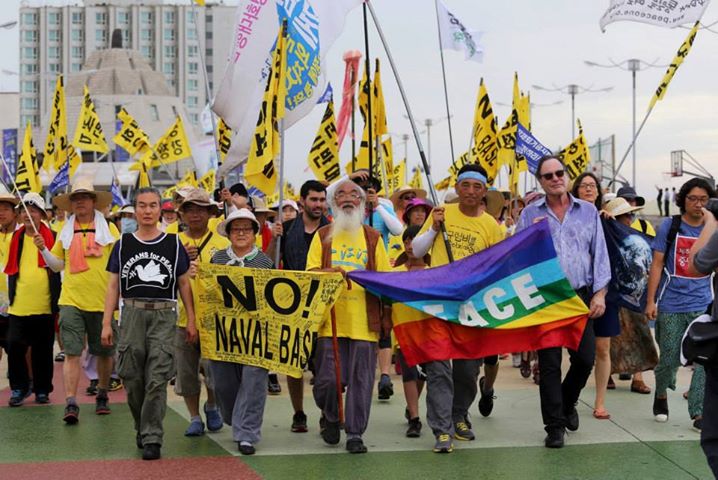
Oliver Stone Visits Jeju Island
by K. J. Noh
In 1986, a young American director burst out on the screens with a raw, charged, kinetic film.  Depicting a country on the verge of popular revolution, it documents the rightwing terror and massacres that are instigated, aided and abetted by the US government. Beginning as the chronicle of a gonzo journalist on his last moral legs, the film starts out disjointed, chaotic, hyper-kinetic; the  unmoored, fragmented consciousness of a hedonic drifter. As the events unfurl towards greater and greater violence, the clarity and steadiness of the camera increase, its moral vision clearer and fiercer, carrying the viewer through a journey of political awakening even as the story hurtles inexorably towards heartbreak, tragedy, and loss.
The name of the director was Oliver Stone. The film was Salvador.   Opened to dismissal, derision and poor distribution, it nonetheless garnered two Oscar nominations and is now lauded as one of the most important films of the period, acknowledged to have influenced the political debate, if not the policy, around Central America at the time. Read the rest of this entry →
Comments Off on An Ecological Jewel
September 24, 2013
By: NCVeditor
Category: Community, Diane Lefer
Bringing Restorative Justice into Los Angeles Schools
by Diane Lefer
In May, when the LAUSD board voted to end the practice of suspending students for “willful defiance,†the blogosphere heated up. Monica Garcia, then board president, was called a moron, and students were referred to as thugs, animals, and savages. Well, guess what, haters? You ain’t seen nothin’ yet.
 Recently, after the school year began with LAUSD rolling out a plan to replace punitive disciplinary measures with the practices of restorative justice, Garcia was applauded by community advocates at a meeting at Loyola Law School. In return, she gave the activists their props: “It’s because of your advocacy,†she said.
The restorative justice initiative was championed by community groups including CADRE, Community Rights Campaign, Dignity in Schools, and Youth Justice Coalition, all committed to keeping kids out of the criminal and juvenile court system and in school. This approach asks, Who was harmed? How can that harm be repaired? What are the needs and responsibilities of the parties? How can the parties be held accountable in a positive and healthy way? Read the rest of this entry →
Comments Off on RJ in LA
September 23, 2013
By: NCVeditor
Category: Politics, Robert C. Koehler
Next Steps for ‘the Other Superpower’
by Robert C. Koehler
“Imagine if we sent 5,000 well-trained nonviolent peacekeepers from throughout the world to protect civilians and work with local civil society in building the peace.â€
 Indeed, imagine if we knew that doing this was an option.
Mel Duncan, co-founder of an organization called Nonviolent Peaceforce, was talking about Syria, the country we almost bombed and maybe still will. In lieu of tossing godlike lightning bolts at Bashar al-Assad, “The CIA has begun delivering weapons to rebels in Syria, ending months of delay in lethal aid that had been promised by the Obama administration,†the Washington Post reported last week.
“The shipments began streaming into the country over the past two weeks, along with separate deliveries by the State Department of vehicles and other gear — a flow of material that marks a major escalation of the U.S. role in Syria’s civil war.â€
So our war with Syria is only partially averted, apparently. It plunges back into something covert, minimally publicized, silently lethal, silently insane: our normal relationship with so much of the world. Read the rest of this entry →
Comments Off on Building Real Peace
September 20, 2013
By: NCVeditor
Category: John L. Murphy, Politics
Exploring the Impact and Legacy of the Occupy Movement
by John L. Murphy
At the outset, I asked myself: “Why a subtitled ‘apocalypse’?” It derives from “the lifting of a veil,” so when a fresh revelation appears it transforms the past as well as  the present; then there’s no going back, only forward. Fresh from finishing a study of attempts to verify the divine presence, God in Proof (2012), Nathan Schneider, jittery and curious, reports “notes” from the revelations emanating from Occupy Wall Street in the late summer of 2011. Thank You, Anarchy: Notes from the Occupy Apocalypse (University of California Press, 2013) investigates an energy more tangible than most theology — yet sharing the spirited, mass appeal of what may elude those less fervent.
Idealistic enough to cheer on the Occupy protests, realistic enough to catalogue their failures, Schneider brings the same alert witness and affable analysis that his book on belief featured. As with any cabal of devotees, Occupy began with commitment by a spellbound few. Zuccotti Park, rechristened by the encampment with its pre-corporate name as Liberty Square, “was a place especially conducive to those of us with obsessive tendencies, who like to be consumed in a given interest or project to the exclusion of all else. There, the god of ordinary life was dead, resurrected in the business of self-reliance.” Read the rest of this entry →
Comment (1)
September 19, 2013
By: NCVeditor
Category: Culture, Politics, Winslow Myers
New Book Spotlights the Life and Work of Dag Hammarskjöld
by Winslow Myers
Roger Lipsey has produced a magisterially comprehensive portrait of the second Secretary-General of the United Nations, Dag Hammarskjöld, in his 2013 book Hammarskjöld: A Life. Lipsey’s achievement is all the more remarkable because at first 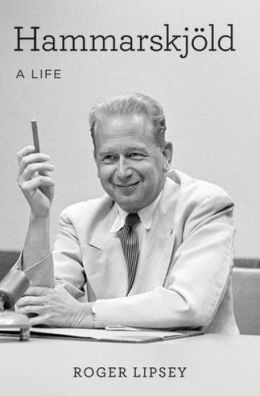 glance Hammarskjöld appears to be, in the combination of his monastic bachelor dedication to his role and his veiled diplomatic tact, a uniquely unknowable person.
As Secretary-General, what kept him steadily moving forward against the gale-force winds of chaos, violence, and cynical double-dealing by governments was his systematic subjugation of individual will to a fervent wish to be used by God. Brought up in Swedish Protestant Christianity, a deep reader of the Christian mystics, Hammarskjöldnot only valued, but actually lived, what he called “stillness,†a creative discipline that enabled him to stay flexibly creative in the welter of such events as the Suez crisis of 1956, when he was one of the first to initiate the exhausting process of shuttle diplomacy.
The working heart of Lipsey’s approach is to subtly tie the entries in “Markings,â€Â Hammarskjöld’s spiritual poetry, a number of which are specifically dated, to the stream of acute international crises in which Hammarskjöld was crucially involved, including the battle for Congolese independence, during which he lost his life in a plane crash — a crash that may not have been accidental. Read the rest of this entry →
Comment (1)
September 18, 2013
By: NCVeditor
Category: Lawrence Wittner, Politics
Eliminating Nuclear Weapons as Important as Eliminating Chemical Ones
by Lawrence S. Wittner
The apparent employment of chemical weapons in Syria should remind us that, while weapons of mass destruction exist, there is a serious danger that they will be used.
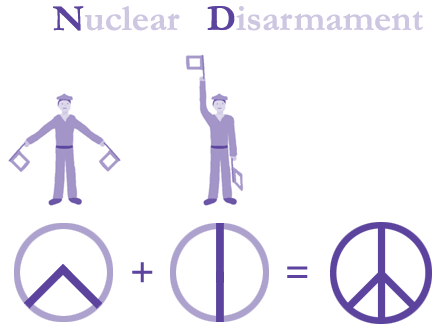 That danger is highlighted by an article in the September/October 2013 issue of the Bulletin of the Atomic Scientists. Written by two leading nuclear weapons specialists, Hans Kristensen and Robert Norris of the Federation of American Scientists, the article provides important information about nuclear weapons that should alarm everyone concerned about the future of the planet.
At present, the article reports, more than 17,000 nuclear warheads remain in the possession of nine nations (the United States, Russia, Britain, France, China, Israel, India, Pakistan, and North Korea). Over 90 percent of that inventory consists of U.S. and Russian warheads. Read the rest of this entry →
Comment (1)