Archive for the ‘Politics’
November 09, 2011
By: NCVeditor
Category: Community, Ecology, Economy, Harry Targ, Politics
Another World Was — and Still Is — Possible
by Harry Targ
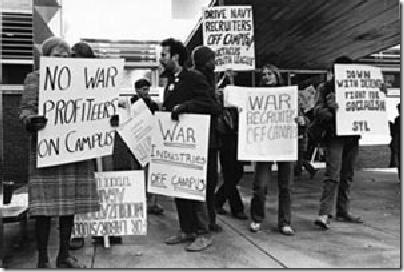
A powerful concept animated the vision of young people in the 1960s, the idea of community. Many of us came to that decade with little interest in politics. We  were not “red diaper†babies but we became outraged by Jim Crow, McCarthyism, and war. Our education had communicated an early version of Margaret Thatcher’s admonition, “there is no alternative,†and our impulses told us then that “another world was possible.â€
New and old ideas about a better world began to circulate from college campuses, the streets, some churches, and popular culture. A whole body of engaging literature caught the fancy of young people. (more…)
Comments Off on Building a New Society
November 08, 2011
By: NCVeditor
Category: Current Events, David Swanson, Economy, Politics
Public Pressure Is Slowly Ending the War in Afghanistan
by David Swanson
Feints and baby steps in the direction of eventually ending a massive crime are not enough. Hoping to meet a distant deadline for  ending a war that cannot be justified for a single day is not enough. A new misunderstanding should not be piled on top of other fictional accomplishments (the closing of Guantanamo, the complete withdrawal from Iraq, universal health coverage, etc.). But if we don’t understand that we are beginning to move things in the right direction many among us will lose heart and others will miscalculate. (more…)
Comments Off on Paying Dividends
November 03, 2011
By: NCVeditor
Category: Culture, Politics, Robert C. Koehler
Finding Hope in the Failure of War
by Robert C. Koehler
This won’t be Vietnam, exactly. No helicopter whisking the last remaining Americans off the roof of the embassy. A contingent of  16,000 State Department contract employees — over 5,000 of them armed mercenaries — will be staying on, running what’s left of the American operation in Iraq.
But there’s little doubt we lost this war — by every rational measure. Everyone lost, except those who profited from (and continue to profit from) the trillions we bled into the invasion and occupation; and those who planned it, most of whom remain in positions to plan or at least promote the wars we’re still fighting and the wars to come. (more…)
Comments Off on Iraq Syndrome
November 02, 2011
By: NCVeditor
Category: Economy, Politics, Robert Reich
The Occupiers Strike a Responsive Chord
by Robert Reich
A combination of police crackdowns and bad weather are testing the young Occupy movement. But rumors of its demise are premature, to say the least. 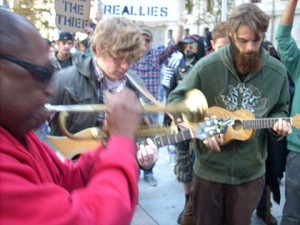 Although numbers are hard to come by, anecdotal evidence suggests the movement is growing.
As importantly, the movement has already changed the public debate in America.
Consider, for example, last week’s Congressional Budget Office report on widening disparities of income in America. It was hardly news — it’s already well known that the top 1 percent now gets 20 percent of the nation’s income, up from 9 percent in the late 1970s. But it’s the first time such news made the front page of the nation’s major newspapers. (more…)
Comment (1)
October 31, 2011
By: NCVeditor
Category: Community, Current Events, David Swanson, Politics
Occupy the Winter of Our Discontent
by David Swanson
Can occupations survive a winter of global weirding, escalated police brutality, and the corporate media’s venom? Should they?
 In some parts of the country there will be no cold weather. In others, police abuses will result in larger occupations, not smaller. And it’s certainly possible that for the first time in recent years an independent progressive populist campaign will survive the enmity of the corporate media.
In other cases, the cold, the communications assaults, fatigue, and the difficulties encountered by activist camps that also become homes for the homeless and the mentally ill may begin to erode the usefulness of encampments. What to do? (more…)
Comment (1)
October 28, 2011
By: NCVeditor
Category: Current Events, Economy, John Clark, Politics
Emancipate Yourselves from Mental Slavery…
by John Clark
When Occupy Wall St. burst unexpectedly on the scene a mere month ago, many (and especially many in the mainstream media) had 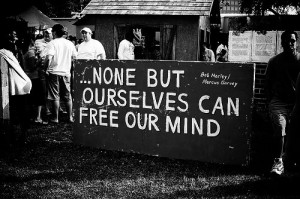 no idea what to make of it, and treated it as an incoherent outburst. We need to consider why this phenomenon was so perplexing to some, while so inspiring to many others. We need to see that the Occupy Movement does have a deep significance. Yet, we also need to be careful not to attempt to pin down its meaning too rigidly at this early point in its development.
It is crucial to understand that “Occupy Wall St.†is a floating signifier. This means that although it may have a common core of meaning for many, it also means many different things to many different people. There is simply no way to pin down what it “really means.â€Â What it really means is everything it is, and everything it will become. Its various meanings at this stage of its evolution sometimes overlap and sometimes conflict. (more…)
Comments (3)
October 27, 2011
By: NCVeditor
Category: Community, Culture, Guest Author, Politics
The Occupy Movement: What Democracy Looks Like
by Ivan Boothe
In my last post, I talked about how the “Occupy†movement originated, and its potential to provide a space for renewed social justice 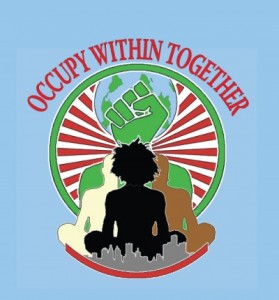 and community organizing. In this blog, I’ll take a look at how “Occupy†events are structured and organized, drawing on my involvement with Occupy Philadelphia. I’ll also highlight some of the constructive criticism surrounding Occupy Wall Street and similar events — in particular as it relates to anti-racism and racial justice.
The Process Story
In political campaigns, there’s nothing a candidate’s staff hates more than news coverage of the campaign itself — staff changes, changes to an event schedule, behind-the-scenes negotiations with other campaigns, political party officialdom. It’s called a “process story,†and it’s frustrating to campaign staff because it takes the focus off of the candidate’s message and policies — usually positive, aspirational language — and places it on the campaign bureaucracy, inevitably leading to feelings of cynicism when people read about the “sausage making†of running for office. (more…)
Comments Off on The Process Is the Demand
 were not “red diaper†babies but we became outraged by Jim Crow, McCarthyism, and war. Our education had communicated an early version of Margaret Thatcher’s admonition, “there is no alternative,†and our impulses told us then that “another world was possible.â€