New Clear Vision


constructive commentary for the chronically farsighted


Archive for the ‘Community’

I Have Just Two Words for You…

February 04, 2011 By: NCVeditor Category: Community, Ecology, Economy, Jay Walljasper, Politics

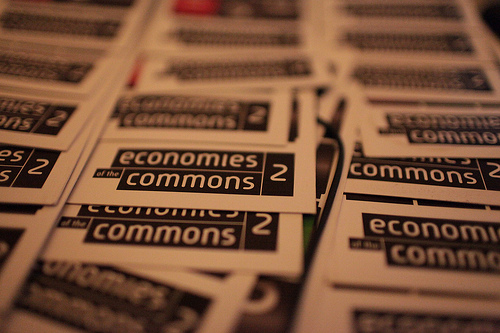
“The Commons” — Lifeblood of Our Communities

by Jay Walljasper

Even if you’ve never seen the movie, you know the line from The Graduate when Benjamin, the befuddled recent college grad, is accosted by one of his dad’s friends with this unsolicited career advice: “I want to say one word to you … Plastics!”

Well, I’m feeling the same way about two words: “The Commons!”

The commons means “all that we share and the ways we share it” — an immense bounty of wealth that belongs to each of us. This covers air and water, national parks and city streets, scientific knowledge and the latest dance steps.

And I believe the spirit and practice of the commons is crucial to making our cities and towns better places for everyone to live. All the places where people connect in our neighborhoods — sidewalks, parks, coffeeshops, community gardens, libraries, bike trails, transit, even the streets — are commons. And so are all the ways we connect — activist groups, online networks, informal gatherings, recreational activities. (more…)


Notes on the Solidarity Economy

February 02, 2011 By: NCVeditor Category: Community, Devon G. Pena, Ecology, Economy

Replacing the Predatory with the Complementary

by Devon G. Peña

By now it is eminently apparent that both Left- and Right-wing politicians alike have it wrong when it comes to re-imagining the future of “making stuff” in the U.S. The question is not just: What do we make?  It is also: How do we make it?

We can begin to answer this by presenting an ideal type in the form of a purely heuristic “imagine that…” type of exercise. The conceptual distinction I wish to make is between a “predatory” economy at one end of the continuum and a “solidarity” economy at the other. I invite readers to engage this exercise of exploring both ends of this continuum, for the sake of analytical discourse and concrete possibilities alike.

Indeed, while the problems before us are manifold, it is equally the case that the answers we seek are closer at hand than it might otherwise appear. (more…)

Apocalypse Not Now

February 01, 2011 By: NCVeditor Category: Community, Culture, Ecology, Politics, Randall Amster

In Search of a New Beginning … Before the End

by Randall Amster

Undertaking even a cursory review of the news queue evidences the apocalyptic overtones in our collective midst. In the most recent additions to the canon, 2010 ended with semi-sardonic coverage of the so-called “Snowpocalypse” and its aftermath, and 2011 began with perplexed musings over the “Aflockalypse” in which birds and fish seem to be dying in odd ways due to mystifying causes. Not long before, we had the perceptive invocation of the “Shopocalypse” by Reverend Billy and the Church of Stop Shopping, and next year’s 2012 allusions promise to spawn a new generation of nomenclatural evolutions.

While we may be tempted to dismiss the suffix “-ocalypse” being deployed much like “-gate” as an all-purpose distortion device, on another level we can also perceive that its very utilization as both a linguistic tool and interpretation of concrete outcomes is telling about the times in which we live. We’re actually in good company on this, at least historically speaking, as the sense of looming apocalypse has been woven into the fabric of Western civilization since its earliest days of recorded reckoning. And there certainly has been no shortage of cataclysmic harbingers in the modern era, from the inception of cinema itself to the invocation of the “mushroom cloud” as part of political theater. This is, in short, our cultural talisman, and its influence upon us is palpable. (more…)

Bikesharing in the U.S.

January 30, 2011 By: NCVeditor Category: Community, Ecology, Jay Walljasper

Minneapolis Program Demonstrates Successful Model

by Jay Walljasper

For all those who dismissed bike sharing as a woolly-headed European idea that would never work on the mean streets of U.S. cities, the success of the first season of the Minneapolis Nice Ride bike program will come as a surprise.

700 public bikes hit the streets in June at 65 stations, and they were taken for more than 100,000 rides until put away for the winter in mid-November. 1300 people signed up for an annual membership and 30,000 signed up for a $5 daily pass with the swipe of a credit card.

But the numbers that may be more significant for the future of bike sharing are three, two and none. That’s the number of bikes vandalized, the number of bikes stolen and the numbers of injuries reported. This conclusively answers numerous skeptics who thought that sharing bikes would never work here in the individualistic, auto-crazed USA. (more…)

Dreams of the Local Commissariat

January 28, 2011 By: NCVeditor Category: Community, Devon G. Pena, Ecology, Economy

Walmart, Food Deserts, and Genuine Sovereignty

by Devon G. Peña

Let us begin with a “defining moment,”  courtesy of the Oxford World Dictionary:

Commissariat (kɒmɪˈsɛːrɪət)

Definition: chiefly Military department for the supply of food and equipment.

Origin: late 16th century (as a Scots legal term denoting the jurisdiction of a commissary, often spelled commissariot): from French commissariat, reinforced by medieval Latin commissariatus, both from medieval Latin commissarius ‘person in charge’, from Latin committere ‘entrust’

How does this relate to the news cycle? Well, on January 20, Walmart announced plans to reformulate the ingredients of their in-house or private brand processed foods. An estimated 60 percent of the company’s annual grocery revenues are currently tied to the sale of processed food items. It is therefore expected that this formula change will place pressure on other private suppliers to follow suit. (more…)

Water, Water Everywhere…

January 26, 2011 By: NCVeditor Category: Community, Ecology, Randall Amster

Sustaining Scarce Resources in the Desert

by Randall Amster

Life in the desert southwest is richly complex and oftentimes a great challenge. A hint of frontier culture remains even as rampant growth and homogenization take hold at breakneck speed. People love the landscapes and the history, but can still sit and watch both disappear in the name of “progress.” At times it seems as if a strange double consciousness exists here, nowhere more prominently than in our relationship to water.

It’s interesting to live in a place where you regularly see coyotes, roadrunners, hawks, antelopes, and javelina (just to name a few local species) with packs of the latter still roaming through our downtowns. People have horses in their front yards, gunracks on their cars, and cacti in their burritos. In a few hours time you can go from a densely-packed urban center to the Grand Canyon, watching the landscape change from desert hills to mountain forests and back again. Despite ubiquitous strip malls, golf courses, and backyard swimming pools, the southwest is still magical in many ways. (more…)

The Moral Economy of Nonviolence

January 21, 2011 By: NCVeditor Category: Community, Culture, Devon G. Pena, Family

Learning Peacefulness from the Zapotecas

by Devon G. Peña

Pundits and analysts have engaged in mostly thoughtful discussions of the social, cultural, and political contexts of the recent mass murder in Arizona. According to Michael Nagler, there is growing recognition of “an apparently forbidden truth: that we bring violence on ourselves when we promote it, glorify it, or legitimize it — as in this case by the extreme rhetoric associated with Sarah Palin and the Tea Party, among others.” Still, for every such in-depth analysis of the issue, there are others content to remain on the surface.

Was the Tucson massacre a form of political violence? Some have argued that it was, by virtue of the fact that the principal target was an elected official. Many on the right, including Palin, have objected to this characterization, arguing that “blaming the right” or any one else is intrinsically unfair and that the mindless crime occurred simply because the perpetrator was mentally ill and unhinged. Since the assassin was ‘sick,’ this cannot be seen as a ‘political act.’ The allegedly deranged mental state of the perpetrator becomes an opening to ‘de-politicize’ the crime. This is, simply put, a ruse. (more…)

  • Welcome to NCV

    A (relatively) NEW blog filled with (generally) CLEAR intentions and a (positive) VISION for the future.
  • Latest Posts

  • GONE, NOT FORGOTTEN

    Since launching in 2010, we featured many inspiring writers on cutting-edge issues. In times of escalating crises, we sought to remain proactive rather than perpetually reactive, to not give more power to those who would co-opt the agenda, and to try turning visions in practice. We can critique what is and offer insights into what could be, without becoming embittered in the process. We weren't partisan, but we'll always stand on the side of those who desire peace with justice. We're not posting anymore new content as of 2017, but our archive will remain up and you can still find us on social media. We'll see you in the interwebs...
  • New! Thematic ‘Zines

  • Tags

  • Archives

  • NCV Bookmarks

    Peace Ecology
  • Green by DreamHost

    carbon neutral * renewable energy
    Green Web Hosting! This site hosted by DreamHost.