Tenacious Spirit
New Book Spotlights the Life and Work of Dag Hammarskjöld
by Winslow Myers
Roger Lipsey has produced a magisterially comprehensive portrait of the second Secretary-General of the United Nations, Dag Hammarskjöld, in his 2013 book Hammarskjöld: A Life. Lipsey’s achievement is all the more remarkable because at first 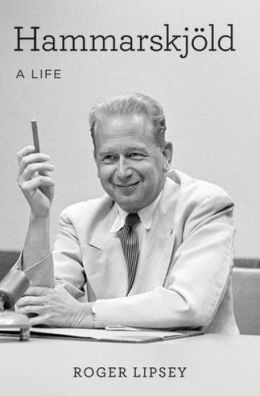 glance Hammarskjöld appears to be, in the combination of his monastic bachelor dedication to his role and his veiled diplomatic tact, a uniquely unknowable person.
As Secretary-General, what kept him steadily moving forward against the gale-force winds of chaos, violence, and cynical double-dealing by governments was his systematic subjugation of individual will to a fervent wish to be used by God. Brought up in Swedish Protestant Christianity, a deep reader of the Christian mystics, Hammarskjöldnot only valued, but actually lived, what he called “stillness,†a creative discipline that enabled him to stay flexibly creative in the welter of such events as the Suez crisis of 1956, when he was one of the first to initiate the exhausting process of shuttle diplomacy.
The working heart of Lipsey’s approach is to subtly tie the entries in “Markings,â€Â Hammarskjöld’s spiritual poetry, a number of which are specifically dated, to the stream of acute international crises in which Hammarskjöld was crucially involved, including the battle for Congolese independence, during which he lost his life in a plane crash — a crash that may not have been accidental. (more…)
 blinked? Of course the world almost ended, but never mind.
 Aside from debate about whether our government may be massively violating the 4th Amendment, we need to begin with compassion. It is not hard to see how fear and political necessity are among the engines driving the growth of the secrecy bureaucracy. There are bad actors out there, and a certain alertness is required to prevent them from doing their worst. Political leaders do not get elected by advocating love for enemies.
 Syrian situation might have led to a war that ended the world.
 Islam: “No one of you is a believer until he desires for his brother what he desires for himself.†Christianity: “Do unto others as you would have them do unto you.†Erikson’s theme was the creative potential of mutuality — between spouses, parents and children, doctors and patients, teachers and pupils, even between nations. Mutuality, Erikson asserted, is a relationship in which partners depend upon each other for the enhancement of their respective strengths.  The curiosity of a student elicits from the teacher the skills for transmitting the excitement of learning in a way that benefits both teacher and student.
 Computer modeling tells us that if even a small fraction of the world’s nuclear arsenals are detonated in a war, doesn’t matter where — could be Pakistan-India, Israel-Iran, U.S.-Russia or China or Iran—the amount of soot thrown skyward could curtail agriculture on the planet for a decade — effectively a death sentence for all.

