Wealth vs. Money
Resisting the Forces of Privatization and Commodification
by Robert C. Koehler
“There is no patent. Could you patent the sun?â€
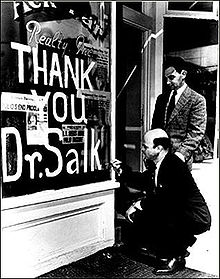 The words are those of Jonas Salk, developer of the polio vaccine, speaking to Edward R. Murrow in 1955, as quoted recently in an essay by Paul Buchheit. What was he thinking? Six decades later, the words have such a counter-resonance with prevailing thought. They exude an old-fashioned humility and innocence, like . . . striking it rich isn’t necessarily the ultimate point of life?
I read these words and sense so much spilled wisdom in them, so much wasted hope. The world we’ve created is governed these days by two unquestioned principles: commodify and dominate. And it’s chewing up the resources that used to belong to every occupant of the planet.
“Eighty people hold the same amount of wealth as the world’s 3.6 billion poorest people, according to an analysis just released from Oxfam,â€Â Mona Chalabi wrote in January at FiveThirtyEight.com. “The report from the global anti-poverty organization finds that since 2009, the wealth of those 80 richest has doubled in nominal terms — while the wealth of the poorest 50 percent of the world’s population has fallen.†(more…)
 He watched her from behind a sea of glass. Comfortable, yet irritated at the faint smell of lemon air purifier wafting from the restrooms down the hall, he wished the lemon smell, and the smells they meant to cover, could be contained. Those things weren’t meant for the public nose.
 Nunez should know. He served as Mayor Koch’sÂ
Nunez should know. He served as Mayor Koch’s  might be headed south. Nestled in among the, “Gee Virginia, don’t depend on Santa Claus,” rallying cries is the supposition that it might just be because — according to the National Retail Federation — “consumers report they expect to have tight budgets this year, despite a recovering economy.”
 the home he shared with her, then an aunt and three others. On October 28, police officer Christopher Robinson shot and killed his ex-girlfriend and her firefighter boyfriend near Baltimore, Maryland. Robinson then committed suicide. In New York City, a relative hacked to pieces a mother and her four young children. Bryan Sweatt, who called 911 and told the operator he was “stressed out,†broke into his girlfriend’s home in Greenwood, South Carolina, where he duct-taped her then shot and killed her and four others, including two children, before killing himself.
 Later, mid-afternoon, as I walked to the grocery, a disheveled man approached. “Can you spare a dime? I need something to eat,†he said. I started to tell him I’d tossed one on his behalf just hours before — that if my wish came true, he wouldn’t be hungry. No one would.
 This was Palm Sunday, in a church basement in a big-city neighborhood, and the time had come to stand for something enormous. My God, a six-month-old baby, Jonylah Watkins, was shot and killed this month in Chicago, as her father held her on his lap while sitting in a parked van. That was just the latest shocker. Violence is the norm, in this city and so many others. The death of children is the norm.
