Blueprint to End War
Excerpt from A Global Security System: An Alternative to War
provided by David Swanson
In On Violence, Hannah Arendt wrote that the reason warfare is still with us is not a death wish of our species nor some instinct of aggression, “. . .but the simple fact that no substitute for this final arbiter in international affairs has yet appeared on the political scene.” The Alternative Global Security System we describe here is the substitute.
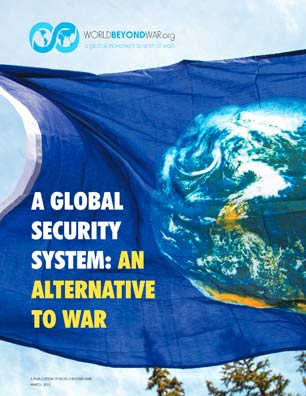 The goal of this document is to gather into one place, in the briefest form possible, everything one needs to know to work toward an end to war by replacing it with an Alternative Global Security System in contrast to the failed system of national security.
For nearly all of recorded history we have studied war and how to win it, but war has become ever more destructive and now threatens whole populations and planetary ecosystems with annihilation in a nuclear holocaust. Short of that, it brings “conventional” destruction unimaginable only a generation ago, while looming global economic and environmental crises go unattended. Unwilling to give in to such a negative end to our human story, we have begun to react in positive ways. We have begun to study war with a new purpose: to end it by replacing it with a system of conflict management that will result, at the very least, in a minimal peace. This document is a blueprint for ending war. It is not a plan for an ideal utopia. It is a summary of the work of many, based on many years of experience and analysis by people striving to understand why, when almost everyone wants peace we still have wars; and on the work of countless people who have real-world political experience in nonviolent struggle as a substitute for war. Many of these people have come together to create World Beyond War. (more…)
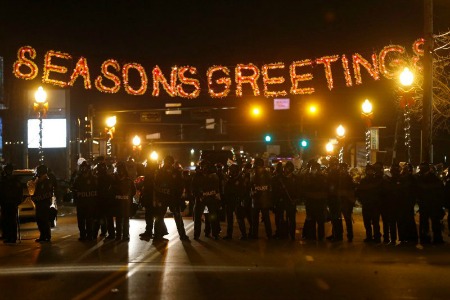
 My God. There’s more darkness in this quote than the New York Times intended. I winced when I read these words of Ottmar Edenhofer, co-chairman of the committee that wrote the latest United Nations Intergovernmental Panel on Climate Change IPCC report, which the Times quoted in a recent editorial headlined “
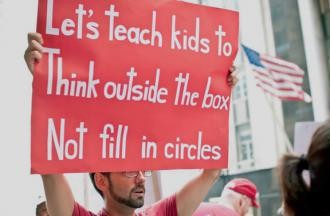 “In every work of genius we recognize our own rejected thoughts: they come back to us with a certain alienated majesty.â€Â What if?
 destiny. Whatever affects one directly, affects all indirectly.†In other words, the very existence of injustice has implications for us all. Thus, we each have a responsibility to actively challenge unjust power structures wherever they should surface. According to the United Nations, “the immortal words of Dr. Martin Luther King, Jr. have never been more relevant than they are today.†Structural injustices are pervasive in the United States, perhaps more than in any other Western industrialized nation. They include record levels of economic inequality and mass incarceration and attempts to slash entitlement programs, restrict women’s reproductive rights, and erode voting rights. Globally, injustice exists more frequently in other forms, such as poverty, hunger, worker exploitation, sex trafficking, resource privatization, and severe restrictions on women’s and gay rights. In every corner of the world people’s rights and dignity are under constant assault by different forces.
  I suppose some people will leave Dirty Wars imagining that we need clean wars, whatever those would be. But too many people seem to be drawing from The Square lessons they brought with them to it, including these: Thou shalt have a leader; thou shalt work within a major political party; thou shalt have an identifiable group of individuals ready to take power. I don’t think following these commandments would have easily changed the past three years in Egypt; I don’t think they’re where Egyptians should be heading; and I’m even more confident they’re blind alleys in the United States — where they serve as supposed remedies for the supposed failings of Occupy.
  months before you plan to officially launch, and when a large percentage of the people signing on ask how they can donate funding, and when people from other countries volunteer to translate your declaration into other languages, and when committees form of volunteer women and men to work on a dozen different aspects of the planning — and they actually get to work in a serious way, and when none of this is due to anything in the news or any statement from anyone in government or any contrast between one political party and another, then it’s time to start thinking about what you’re going to help build as a movement.
