New Clear Vision


constructive commentary for the chronically farsighted


In Defense of Schoolyard Gardens

February 21, 2011 By: NCVeditor Category: Community, Culture, Ecology, Guest Author

Youth Gardening as a Pathway to Academic Success

by Tessa James, Kalyn Janae Marab, and Sabine Parrish

Caitlin Flanagan’s 2010 article in The Atlantic, Cultivating Failure, ridicules the idea that schoolyard gardens can help children in any way become better educated.  Her principal argument is that gardens do not teach students the necessary skill sets to pass the standardized examinations required of most students across the nation:

“Here is the essential question we must ask about the school gardens: What evidence do we have that participation in one of these programs — so enthusiastically supported, so uncritically championed — improves a child’s chances of doing well on the state tests that will determine his or her future (especially the all-important high-school exit exam) and passing Algebra I, which is becoming the make-or-break class for California high-school students?”

Contrary to this statement, there is growing evidence that gardening cultivates not just crops but young minds. This includes teaching environmental consciousness — but gardening can also teach practical and applied lessons in science and math and is an engaging and creative way to explore natural and cultural history.  The question should not be, “Will our students pass these tests?” Instead, we might ask: “Why have we developed a system in which standardized tests determine our children’s future?” (more…)

Shoulders to the Wheel

February 11, 2011 By: NCVeditor Category: Community, Culture, Ecology, Randel Hanson

Laying the Foundations for Sustainable Local Food Systems

by Randel Hanson

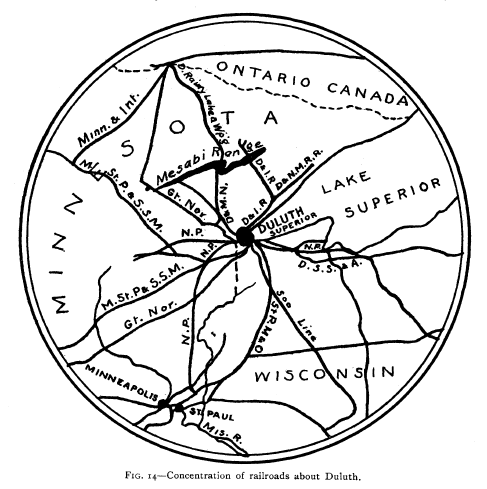
How do you create a locally harvested food system for a city of 100,000? This question is being asked presently in a seminar, in Duluth, Minnesota and the broader western Lake Superior region, as well as in many other cities across the United States. It was also an urgent local question a century ago.

Indeed, across the U.S. at the onset of the 20th century, public and private concerns were scrambling to get a handle on the haphazard ‘system’ that transformed nature into edible human culture within the rapidly urbanizing America. This was a chaotic, wasteful, and powerfully transformative period, with rural populations shifting into cities as the primary engine for economic activities turned from agrarianism to industrialization. The rapid growth of industrial cities forced an emerging ‘municipal responsibility’ for the various inputs and outputs of urban life. Public and private city planners in the late 19th century began to reflect upon and intervene into this laissez faire urbanization, including how to procure ample food of adequate quality and cost to citizens. In short, it became quite apparent that leaving the issue of food to the market was wholly inadequate to the demands of society from any number of perspectives. (more…)

The Economy of Poetics

February 10, 2011 By: NCVeditor Category: Community, Ecology, Economy, Victor Postnikov

On the Virtues of Self-Sustaining and Simple Living

by V.I. Postnikov

“Let the beauty we love be what we do.” – Rumi

“The environmental crisis is the crisis of aesthetics.” – James Hillman

“The poet knows of no ‘waste’…. Ecopoetics is the way of thinking economically.” – Hwa Yol Jung

It is the right time for poets and artists to engage in economics. We can’t allow the greedy and self-important “experts” and “economists” to push the world to the brink of catastrophe. A lot has already been written and said about the impending collapse — I won’t repeat it.

The idea is that the systemic collapse could be prevented, or, at least, alleviated, by invoking an inner artist in everyone and directing the artistic creativity to the dismantling of the Mega-Machine. Roughly speaking, in order to survive, we need to decentralize the economy as soon as possible by reducing it to an individual craftsmanship. I understand all the objections and losses involved, even fierce opposition, but the gains are superlative. Ultimately, people will see it as the only strategy, whether pre- or post-collapse.

(more…)

I Have Just Two Words for You…

February 04, 2011 By: NCVeditor Category: Community, Ecology, Economy, Jay Walljasper, Politics

“The Commons” — Lifeblood of Our Communities

by Jay Walljasper

Even if you’ve never seen the movie, you know the line from The Graduate when Benjamin, the befuddled recent college grad, is accosted by one of his dad’s friends with this unsolicited career advice: “I want to say one word to you … Plastics!”

Well, I’m feeling the same way about two words: “The Commons!”

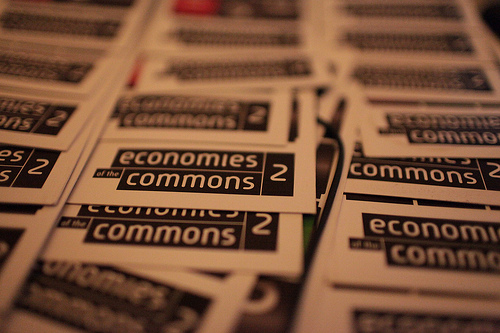
The commons means “all that we share and the ways we share it” — an immense bounty of wealth that belongs to each of us. This covers air and water, national parks and city streets, scientific knowledge and the latest dance steps.

And I believe the spirit and practice of the commons is crucial to making our cities and towns better places for everyone to live. All the places where people connect in our neighborhoods — sidewalks, parks, coffeeshops, community gardens, libraries, bike trails, transit, even the streets — are commons. And so are all the ways we connect — activist groups, online networks, informal gatherings, recreational activities. (more…)

Notes on the Solidarity Economy

February 02, 2011 By: NCVeditor Category: Community, Devon G. Pena, Ecology, Economy

Replacing the Predatory with the Complementary

by Devon G. Peña

By now it is eminently apparent that both Left- and Right-wing politicians alike have it wrong when it comes to re-imagining the future of “making stuff” in the U.S. The question is not just: What do we make?  It is also: How do we make it?

We can begin to answer this by presenting an ideal type in the form of a purely heuristic “imagine that…” type of exercise. The conceptual distinction I wish to make is between a “predatory” economy at one end of the continuum and a “solidarity” economy at the other. I invite readers to engage this exercise of exploring both ends of this continuum, for the sake of analytical discourse and concrete possibilities alike.

Indeed, while the problems before us are manifold, it is equally the case that the answers we seek are closer at hand than it might otherwise appear. (more…)

The Right to a Future

January 31, 2011 By: NCVeditor Category: Culture, Ecology, Family, Guest Author

A New Lens and Lexicon for Navigating ‘Climate Collapse’

by Raffi Cavoukian

Are we tweeting while Earth burns? Is climate collapse our new collective Titanic? How do we best describe the survival struggle of seven billion in a way that connects with the public and with decision makers?

The science on global warming is clear and compelling. Earth is in serious climate crisis. That’s why many writers have recently upgraded climate change to climate collapse, climate catastrophe, the long emergency. To convey the climate threat fully, we need a new Story.

In a well known Greek myth, the very rich King Midas, who loves gold above all else, is granted his singular wish that everything he touches turn into gold. The gift becomes a curse when his golden touch kills plants, food and even his daughter, who is turned into a statue. Bereft and repentant, forsaking greed, the king begs for deliverance. His curse is lifted by a wash in the river. All he holds truly precious is restored. (more…)

Bikesharing in the U.S.

January 30, 2011 By: NCVeditor Category: Community, Ecology, Jay Walljasper

Minneapolis Program Demonstrates Successful Model

by Jay Walljasper

For all those who dismissed bike sharing as a woolly-headed European idea that would never work on the mean streets of U.S. cities, the success of the first season of the Minneapolis Nice Ride bike program will come as a surprise.

700 public bikes hit the streets in June at 65 stations, and they were taken for more than 100,000 rides until put away for the winter in mid-November. 1300 people signed up for an annual membership and 30,000 signed up for a $5 daily pass with the swipe of a credit card.

But the numbers that may be more significant for the future of bike sharing are three, two and none. That’s the number of bikes vandalized, the number of bikes stolen and the numbers of injuries reported. This conclusively answers numerous skeptics who thought that sharing bikes would never work here in the individualistic, auto-crazed USA. (more…)

  • Welcome to NCV

    A (relatively) NEW blog filled with (generally) CLEAR intentions and a (positive) VISION for the future.
  • Latest Posts

  • GONE, NOT FORGOTTEN

    Since launching in 2010, we featured many inspiring writers on cutting-edge issues. In times of escalating crises, we sought to remain proactive rather than perpetually reactive, to not give more power to those who would co-opt the agenda, and to try turning visions in practice. We can critique what is and offer insights into what could be, without becoming embittered in the process. We weren't partisan, but we'll always stand on the side of those who desire peace with justice. We're not posting anymore new content as of 2017, but our archive will remain up and you can still find us on social media. We'll see you in the interwebs...
  • New! Thematic ‘Zines

  • Tags

  • Archives

  • NCV Bookmarks

    Peace Ecology
  • Green by DreamHost

    carbon neutral * renewable energy
    Green Web Hosting! This site hosted by DreamHost.