Like Bees to Nectar
by Chellis GlendinningÂ
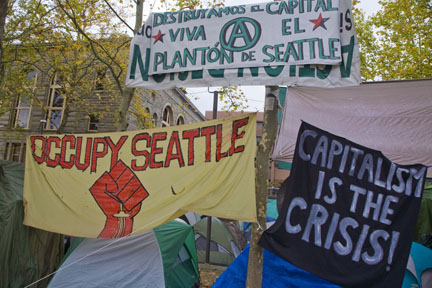
It’s yet another bloqueo, paro y huelga in Bolivia, nary a week passes without one or two or three somewhere in the country. The syndicates, collectives, and communities are in the streets marching, striking, blocking traffic with boulders and tires, hurling rocks at  the police, shooting firecrackers, martyring themselves in hunger strikes — causing havoc, threatening the national economy, pushing the blind eye of government to see their demands. All the while, activists, protestors, and anti-globalization visionaries in “advanced†societies are stunned, inspired, awed. And green with envy.
The campesinos and city folk in Cochabamba’s 2000 Water War, after all, put a stop to an already-signed contract with mega-corporation Bechtel to privatize water sources and delivery, while those in the 2003 Gas War in El Alto brought down a government.
Yes, green with envy. (more…)
 the present; then there’s no going back, only forward. Fresh from finishing a study of attempts to verify the divine presence,
 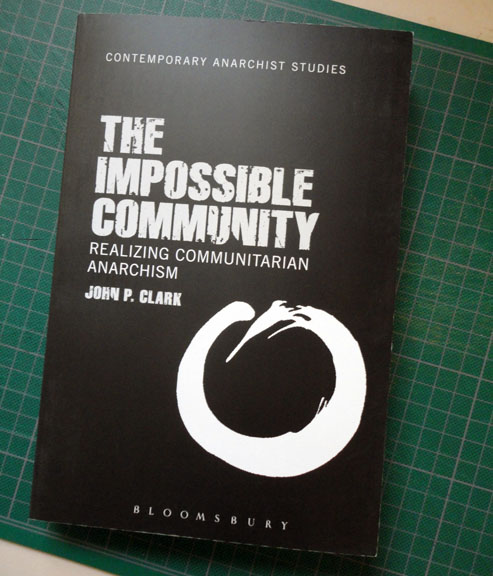 exploitation and domination of one another makes possible similar acts of violence against nature. As long as we remain oblivious to underlying flaws in our collective logic (i.e., that it is reasonable to endlessly consume non-renewable resources on a finite planet; that peaceful, just societies can emerge out of competitive, hierarchical frameworks) any responses we could devise will be insufficient to significantly alter our current course. A social ecological approach to “saving the environment†would require balancing relationships between humans and other humans, and between humans and all other phenomena. It sounds like a tall order…and it is. In light of the obvious destructive effects of systems within which we are obliged to strive for quantity of goods for one over quality of life for all, we are now faced with two choices: pull off the impossible, or perish.
  and originally imprisoned in January 1972 for actions relating to his political involvement. With an extraordinary thirty-plus years spent in solitary confinement — including the past twenty-three years continuously — Maroon’s case is one of the most shocking examples of U.S. torture of political prisoners, and one of the most egregious examples of human rights violations regarding prison conditions anywhere in the world. His “Maroon†nickname is, in part, due to his continued resistance — which twice led him to escape confinement; it is also based on his continued political analysis, including recent writings on ecology and matriarchy that are found in his recently published book: