Are We Having Fun Yet?
Reconsidering War, Video Games, and the Nonviolence Playbook
by Diane Lefer
One morning in October I waited at the gate of the Air Ground Combat Center Marine training base in the Mojave Desert, Twentynine Palms, CA. I’d been invited with a community group about to take a public tour of what is essentially a grad school for combat. Marines from around the country  — units 1,000 members strong — who’ve already completed basic training and are almost ready to deploy come here for 35 days of intensive work, including live-fire training and urban warfare practice in “Little Iraqi villages.â€
“I don’t care if you learn anything today,†said the retired Marine who would lead our tour. “I’m here to keep you entertained. At the end of the day, if you don’t have fun, it’s my fault.â€
But first, our drivers licenses were collected. Quick identity checks “just to make sure you’re not a terrorist.â€
We waited. A woman near the front of the parking lot stared, scrutinizing me.
For a few years, my emails carried an automatic tag at the end: I am a terrorist. By paying US taxes, I provide financial support to State-sponsored terrorism and torture. I don’t remember when I deleted the statement, but it occurred to me my past might have caught up with me.
 three years later, returning for the first time to her homeland, she barely recognized war-torn streets in urban areas where she had once lived.  She saw and felt the anguish of villagers who couldn’t feed or shelter their families, and no less able to accept such unjust suffering than she’d been half her life before, Fahima decided to make it her task to help alleviate the abysmal conditions faced by ordinary Afghans living at or below the poverty line – by helping to build independent women’s enterprises wherever she could. She trusted in the old adage that if a person is hungry it’s an even greater gift to teach the person how to fish than to only give the person fish.
  talk to you about,” Leo Motiuk explained with a smile. “As parents of a young son you just wonder what that’s all going to be about.”
 As has been documented, a huge factor in the shrinking away was partisan delusion. You put a different political party’s name on the wars and they become good wars.
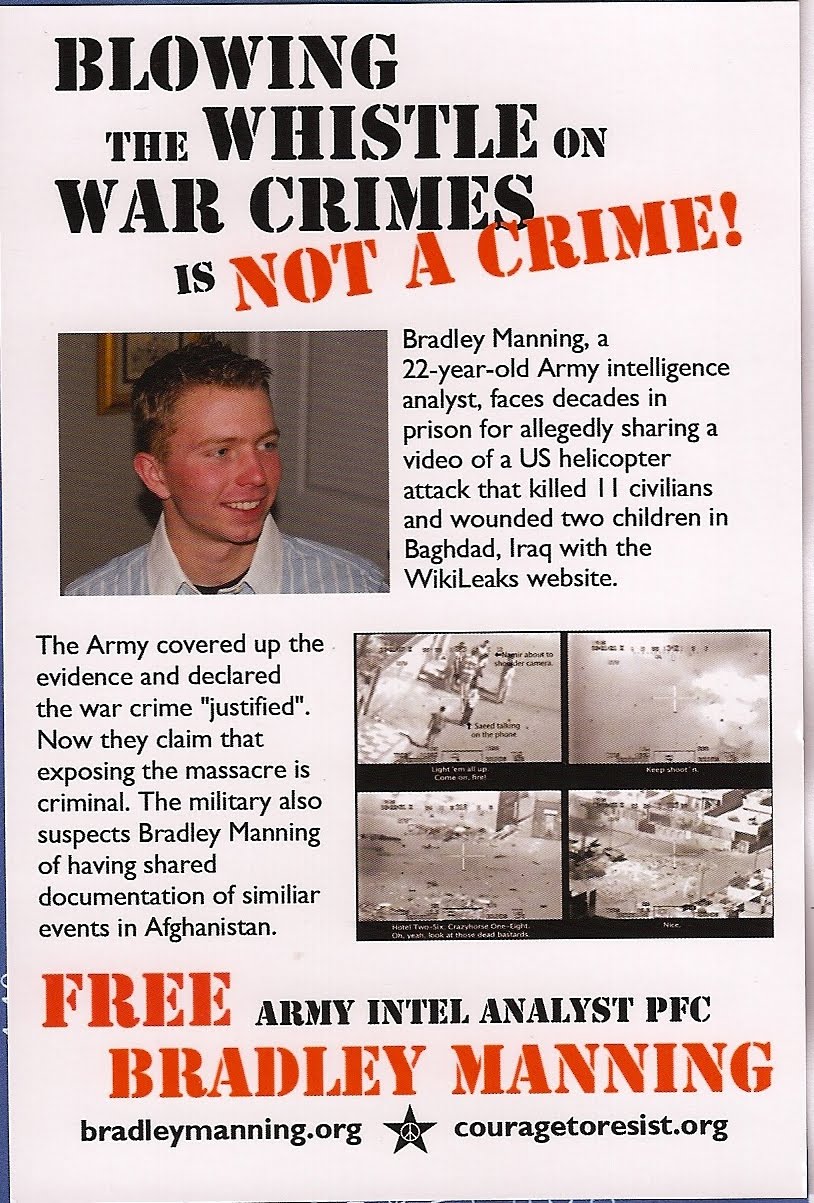
 No individual has done more to push back against what Martin Luther King Jr. called “the madness of militarism” than Bradley Manning. The United States is the leading exporter of weapons and itself spends as much preparing for more wars as the rest of the world combined. Manning is the leading actor in opposition to U.S. warmaking, and therefore militarism around the world. What he has done has hurt the cause of violence in a number of other nations as well.
 sat for hours listening to stories of unbridled corruption on the taxpayer’s dime, conspiratorial advances of arms industries into consumer markets, sexually predatory behaviors deemed an acceptable part of institutional culture, and a resulting pessimistic world perspective that would make a seasoned peace activist cringe.
