New Clear Vision


constructive commentary for the chronically farsighted


Archive for the ‘Politics’

Food Mosaics

October 07, 2013 By: NCVeditor Category: Ecology, Evaggelos Vallianatos, Politics

UN Appeals for Urgent Agricultural Reform

by Evaggelos Vallianatos

I remember going to one of the preparatory meetings on Agrarian Reform and Rural Development at the State Department. It was late 1978 and I represented Congressman Clarence Long (D-Md.).

There must have been at least forty federal bureaucrats around a huge wooden table in a large conference room. I asked them how many peasants they or the United Nations had invited to address the 1979 Agrarian Reform and Rural Development Conference in Rome. After all, who knows more about the pain of the peasants than peasants themselves?

The icy silence that followed my question was a reminder that this conference had nothing to do with food and agriculture or agrarian reform. It was rather a forum for the amusement of men and women from the North and the South who guarded the world’s food and agriculture. (more…)

Occupy Everything

October 04, 2013 By: NCVeditor Category: David Swanson, Politics

Reflecting on Lessons Learned and New Directions

by David Swanson

When the Pentagon ends an occupation, crawling home from Vietnam or Iraq or Afghanistan with its Tomahawk missile dragging between its legs, it declares victory every time.  And, depending on how you define victory, it certainly leaves lasting effects.  The cancer and birth defects and poisoned water supplies bear witness: there was an occupation here.

When the Occupy Movement lost its presence on television and therefore in real spaces that are never quite as real as television, it too left a lasting impact.  But it was a positive lasting impact, difficult as yet to measure fully, but observable in many areas.  (more…)

BRICS and Sticks

October 02, 2013 By: NCVeditor Category: Economy, Matt Meyer, Politics

Deadly Diamonds, Violence, and the Future of South Africa’s Democracy

by Matt Meyer

As the World Economic Forum summit took place in Cape Town in early May 2013, the question of South Africa’s role on the continent and around the globe came into sharp focus. Though the remarks of Zambian Vice President Guy Scott — that South Africa is disliked among Africans for “the same reason that Latin Americans dislike the United States” — were uncharacteristically undiplomatic, many South Africans were forced to admit that Scott’s impression is increasingly on the mark. With South African National Defense Force (SANDF) troops deployed in the Democratic Republic of the Congo, in the Central African Republic, in Liberia, Ethiopia, Mozambique, the Sudan, Burundi and elsewhere, it is not surprising that some analysts — such as University KwaZulu-Natal’s Patrick Bond — call South Africa’s current position nothing short of “sub-imperialist.”

A year after the headline-making “Marikana massacre” of 34 striking mineworkers, and the publication of anti-arms trade whistleblower Terry Crawford-Browne’s damning book Eye on the Diamonds (Penguin, 2012) — which asserts that South Africa has been complicit in the marketing of “conflict” or “blood diamonds” — the question emerges: on the eve of the twentieth anniversary of the end of apartheid and next year’s South African Presidential elections, what does the future hold for this symbol of continental resistance and revolution? (more…)

Looking Backwards

September 27, 2013 By: NCVeditor Category: David Swanson, Politics

On Taking a ‘Winding Path to the Nobel Peace Prize’ 

by David Swanson

Jody Williams’ new book is called My Name Is Jody Williams: A Vermont Girl’s Winding Path to the Nobel Peace Prize, and it’s a remarkable story by a remarkable person.  It’s also a very well-told autobiography, including in the early childhood chapters in which there are few hints of the activism to come.
One could read this book and come away thinking, “Anyone really could win the Nobel Peace Prize” — if people in fact told their children they could do that instead of telling them they could be president, and if one was thinking of Nobel peace laureates as saintly beings.  In a certain sense, of course, anyone can win the Nobel Peace Prize, as it’s often given to good people who have nothing to do with peace, and at other times it’s given to warmongers.  To win the Nobel Peace Prize and deserve it, as Williams did — that’s another story.  That requires not saintliness, but activism.

Activism is usually 99% perspiration and the dedication that drives it, just like genius.  But in the case of the Nobel Peace Prize, and of the sort of rapid success it honors when applied in accordance with Alfred Nobel’s will, the perspiration is 49%.  The other 50% is timing.  The activists who recruited Williams to lead the campaign to ban landmines had the timing perfect. (more…)

An Ecological Jewel

September 25, 2013 By: NCVeditor Category: Ecology, Guest Author, Politics

Oliver Stone Visits Jeju Island

by K. J. Noh

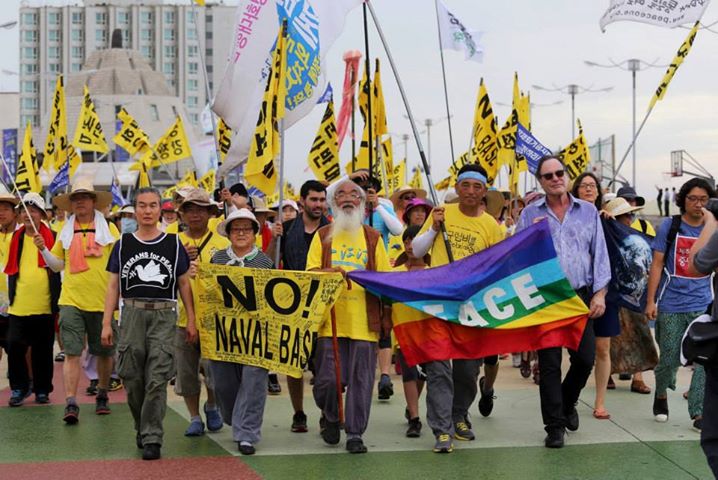
In 1986, a young American director burst out on the screens with a raw, charged, kinetic film.  Depicting a country on the verge of popular revolution, it documents the rightwing terror and massacres that are instigated, aided and abetted by the US government. Beginning as the chronicle of a gonzo journalist on his last moral legs, the film starts out disjointed, chaotic, hyper-kinetic; the March with bannerunmoored, fragmented consciousness of a hedonic drifter. As the events unfurl towards greater and greater violence, the clarity and steadiness of the camera increase, its moral vision clearer and fiercer, carrying the viewer through a journey of political awakening even as the story hurtles inexorably towards heartbreak, tragedy, and loss.

The name of the director was Oliver Stone. The film was Salvador.   Opened to dismissal, derision and poor distribution, it nonetheless garnered two Oscar nominations and is now lauded as one of the most important films of the period, acknowledged to have influenced the political debate, if not the policy, around Central America at the time.  (more…)

Building Real Peace

September 23, 2013 By: NCVeditor Category: Politics, Robert C. Koehler

Next Steps for ‘the Other Superpower’

by Robert C. Koehler

“Imagine if we sent 5,000 well-trained nonviolent peacekeepers from throughout the world to protect civilians and work with local civil society in building the peace.”

Indeed, imagine if we knew that doing this was an option.

Mel Duncan, co-founder of an organization called Nonviolent Peaceforce, was talking about Syria, the country we almost bombed and maybe still will. In lieu of tossing godlike lightning bolts at Bashar al-Assad, “The CIA has begun delivering weapons to rebels in Syria, ending months of delay in lethal aid that had been promised by the Obama administration,” the Washington Post reported last week.

“The shipments began streaming into the country over the past two weeks, along with separate deliveries by the State Department of vehicles and other gear — a flow of material that marks a major escalation of the U.S. role in Syria’s civil war.”

So our war with Syria is only partially averted, apparently. It plunges back into something covert, minimally publicized, silently lethal, silently insane: our normal relationship with so much of the world. (more…)

Lifting the Tent Flap

September 20, 2013 By: NCVeditor Category: John L. Murphy, Politics

Exploring the Impact and Legacy of the Occupy Movement

by John L. Murphy

At the outset, I asked myself: “Why a subtitled ‘apocalypse’?” It derives from “the lifting of a veil,” so when a fresh revelation appears it transforms the past as well as the present; then there’s no going back, only forward. Fresh from finishing a study of attempts to verify the divine presence, God in Proof (2012), Nathan Schneider, jittery and curious, reports “notes” from the revelations emanating from Occupy Wall Street in the late summer of 2011. Thank You, Anarchy: Notes from the Occupy Apocalypse (University of California Press, 2013) investigates an energy more tangible than most theology — yet sharing the spirited, mass appeal of what may elude those less fervent.

Idealistic enough to cheer on the Occupy protests, realistic enough to catalogue their failures, Schneider brings the same alert witness and affable analysis that his book on belief featured. As with any cabal of devotees, Occupy began with commitment by a spellbound few. Zuccotti Park, rechristened by the encampment with its pre-corporate name as Liberty Square, “was a place especially conducive to those of us with obsessive tendencies, who like to be consumed in a given interest or project to the exclusion of all else. There, the god of ordinary life was dead, resurrected in the business of self-reliance.” (more…)

  • Welcome to NCV

    A (relatively) NEW blog filled with (generally) CLEAR intentions and a (positive) VISION for the future.
  • Latest Posts

  • GONE, NOT FORGOTTEN

    Since launching in 2010, we featured many inspiring writers on cutting-edge issues. In times of escalating crises, we sought to remain proactive rather than perpetually reactive, to not give more power to those who would co-opt the agenda, and to try turning visions in practice. We can critique what is and offer insights into what could be, without becoming embittered in the process. We weren't partisan, but we'll always stand on the side of those who desire peace with justice. We're not posting anymore new content as of 2017, but our archive will remain up and you can still find us on social media. We'll see you in the interwebs...
  • New! Thematic ‘Zines

  • Tags

  • Archives

  • NCV Bookmarks

    Peace Ecology
  • Green by DreamHost

    carbon neutral * renewable energy
    Green Web Hosting! This site hosted by DreamHost.