Our Planetary Home
Becoming Part of Gaia’s Cure, Instead of What Ails Her
by Jennifer Browdy de Hernandez
I will never forget one hot summer day when I was about eight years old, and a Monarch butterfly took it into its head to land on my arm and delicately lick up my sweat with its long, probing tongue.
 I froze, wanting the Monarch to stay with me as long as possible, and watched with total fascination and delight as it balanced on my warm brown skin and enjoyed the salty treat I had to offer.
Eventually, with a graceful swish of its elegant wings, it rose up in the air and twirled off to land on a nearby stand of sweet-smelling pink milkweed flowers.
I felt blessed by the encounter, and ever after, when I see a Monarch I approach cautiously and respectfully proffer my arm, hoping to feel again the light touch of those fragile black legs and tiny tongue.
My childhood connection with Monarchs came to mind this week as I read the deeply disturbing news that “the number of monarch butterflies that completed an annual migration to their winter home in a Mexican forest sank this year to its lowest level in at least two decades, due mostly to extreme weather and changed farming practices in North America.†(more…)

 Computer modeling tells us that if even a small fraction of the world’s nuclear arsenals are detonated in a war, doesn’t matter where — could be Pakistan-India, Israel-Iran, U.S.-Russia or China or Iran—the amount of soot thrown skyward could curtail agriculture on the planet for a decade — effectively a death sentence for all.
 globalization and digitization, humankind has been collectively taxing the planet’s carrying capacity and altering basic processes that have sustained our existence for eons. At this juncture, we cannot simply go back to a more pristine time (real or imagined), and the question of where we go from here is an open and urgent one.
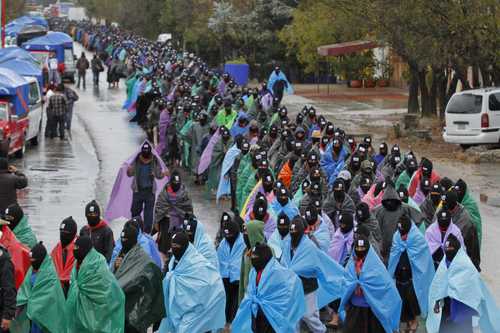 the first day of the New Mayan Era. On that very day, the Zapatistas made a dramatic reappearance. After four years of silence amid speculation about the status of their movement, more than 40,000 Zapatistas appeared in five towns they had occupied by force nineteen years earlier on January 1, 1994 — Ocosingo, Las Margaritas, Altamirano, Palenque and San Cristobal de Las Casas. Inspiring a profound sense of awe, men and women marched silently together in the rain, wearing ponchos and their trademark ski masks, unarmed, with young children on their backs.
  my children’s future. Yet our government continues to manufacture nuclear materials and unsafely store radioactive waste in clear violation of the public trust.Nowhere is this more visible than at the Hanford Nuclear Reservation, the most radioactively contaminated site in the western hemisphere, where we now know radioactive sludge is leaking badly from at least six underground tanks. While Hanford is technically in Washington State, the management of this catastrophe is vitally important to the rest of the nation — indeed, the biosphere. Unfortunately, environmental disasters do not stop at city, state, or national borders.
  Why have we come to understand that?
