Common Lies
Thoughts on People Who Are Wrong…
by David Swanson
Don’t people who are wrong annoy you? I recently read a very interesting book called Being Wrong: Adventures in the Margin of Error, by Kathryn Schulz. Of course I read it with an eye toward figuring out how better to correct those other people who are so  dangerously and aggravatingly wrong. And of course the book ended up telling me that I myself am essentially a creature of wrongness.
But if we’re all wrong, I can live with that. It’s being more wrong than other people that’s intolerable. However, statistics show that most of us believe we’re more right than average, suggesting a significant if not downright dominant wrongness in our very idea of wrongness. Even worse, we’re clearly not wrong by accident or despite the best of intentions. We go wrong for the most embarrassing of reasons — albeit reasons that might serve unrelated purposes, or which perhaps did so for distant ancestors of ours. (more…)
 doesn’t fix what breaks and has ignored the cockroaches that move from rental unit to rental unit easier than a breeze on a cool night. No surprise there, as breezes don’t have legs and the ability to seek out moisture and food.
 (CEML), which she co-founded in 1985 as a response to the lockdown at the federal prison in Marion, Illinois. It quickly turned into a broader campaign against control unit prisons and human rights violations in US prisons that lasted fifteen years, until 2000.  The following excerpt from Out of Control details CEML’s origins:
 as I have to any other relationship. I’m not proud of it. But maybe I’m getting better at putting relationships with people and my environment ahead of money.
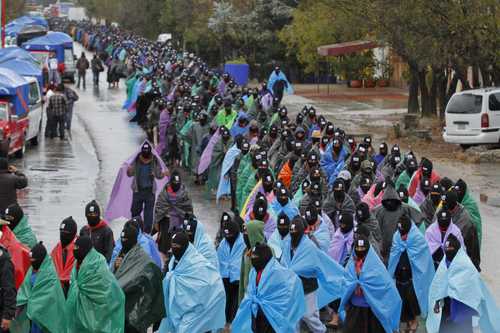 the first day of the New Mayan Era. On that very day, the Zapatistas made a dramatic reappearance. After four years of silence amid speculation about the status of their movement, more than 40,000 Zapatistas appeared in five towns they had occupied by force nineteen years earlier on January 1, 1994 — Ocosingo, Las Margaritas, Altamirano, Palenque and San Cristobal de Las Casas. Inspiring a profound sense of awe, men and women marched silently together in the rain, wearing ponchos and their trademark ski masks, unarmed, with young children on their backs.
  war, the death penalty, nuclear energy, the U.S. Senate, the electoral college, gerrymandering, electronic voting machines, murder, rape, child abuse, Fox News, CNN, MSNBC, and the Washington Post. I could go on. I bet you can think of at least one institution you believe we’d be better off without.
 emergency/state of siege. The second point is that under such a regime, not only is there a suspension of the rule of law, the constituted power of the sovereign is focused on the ability to decide,
