Golden Rule
Sea Level Rise, Eniwetok, and Bert Bigelow
by Jerry Elmer
One of the most talked-about consequences of climate change is sea-level rise. The melting glaciers of Greenland could cause a rise of 7 meters, and in March 2014 scientists learned that Greenland’s glaciers are melting much faster 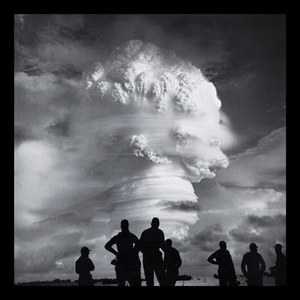 than previously believed. The melting West Antarctic ice shelf could cause an additional sea-level rise of 5 meters – and in May 2014 it was learned that that ice mass is also melting far more quickly than previously known.
Two-thirds of the world’s cities with populations above 5 million people would be inundated by a sea level rise of only 3.5 meters – and that is not even accounting for storm surges from increasingly powerful hurricanes (think Katrina and Sandy). Bangladesh, Vietnam, China, Indonesia and the Philippines (the last two are archipelagos) will be particularly vulnerable by the rising sea level, and atoll nations such as Maldives and the Marshall Islands may literally cease to exist.
It is in this context that the long-forgotten name of Bert Bigelow may re-emerge in the twenty-first century. But before I tell you about Bigelow, I need to tell you something about Eniwetok. (more…)
 guest at the Greek table.
 and some European nations would like to see the bombs withdrawn from Europe.
 For me, the question that immediately follows is: What kind of politics draws power from resources other than the deep pockets of billionaires? Just because the world is sick of war, how will that ever translate into serious political action to defund standing armies and ongoing weapons research? How will it ever cohere into a consensus that has political traction? Does Washington, D.C. only have room for one consensus?
 That danger is highlighted by an article in the September/October 2013 issue of the Bulletin of the Atomic Scientists. Written by two leading nuclear weapons specialists, Hans Kristensen and Robert Norris of the Federation of American Scientists, the article provides important information about nuclear weapons that should alarm everyone concerned about the future of the planet.
 massively impact health and life everywhere on Earth. How can we respond to something so overwhelming, so huge, so threatening that there is nowhere to hide except in denial? We’ve been trying that for almost 70 years. The numbers of weapons are down, their accuracy and lethality are up. It is time to try something new.
 To various degrees, these practices — and many others — have been eliminated or reduced and stigmatized.
