New Clear Vision


constructive commentary for the chronically farsighted


Our Better Angels?

March 05, 2012 By: NCVeditor Category: Culture, Guest Author, Politics

Stacking the Shelves with Peace

by Jake Olzen

Scholars and students in peace and nonviolent studies find their bookshelves teeming with new and intriguing works on violence, conflict, and social change. In the past year, a number of very important books — not all without controversy — have appeared, and are widely available, that have taken seriously the inquiry of what will it take for peace and a world without war. Two scholars in particular, Steven Pinker in The Better Angels of Our Nature: Why Violence Has Declined and Joshua S. Goldstein in Winning the War on War: The Decline of Armed Conflict Worldwide, argue that humanity is actually becoming less violent. In fact, Goldstein and Pinker penned a piece for The New York Times Sunday Review that was published at the end of December 2011 titled: “War Really is Going Out of Style.” The boldness and veracity of their claims — in that article and their books — come from different perspectives, but is suggestive of a new consciousness that reflects the global interconnectedness made possible by the Internet and intertwined economies as well as the increasing prominence of nonviolence in the mainstream purview. The 2011 publishing of The Oxford International Encyclopedia of Peace confirms the serious role inquiries into war, peace, nonviolence, and social change have in the classroom as well as affirms a growing dexterity with alternatives to war. (more…)
A Story and a Book

February 15, 2012 By: NCVeditor Category: Community, Matt Meyer, Politics

On the Nature of Violence and Nonviolence

by Matt Meyer

Amidst a bombardment of Black Bloc commentary, questions about the militarized nature of tear-gas toting police, and the ever-frustrating all-too-abstract dialogues about the meanings of nonviolence, violence, strategy, tactics, and principles, comes a simple story (and a complicated book) straight out of Occu-politics. First, though, some defining of terms:

Nonviolence (a term some have called ‘a word seeking to describe something by saying what it is not’) is used in as wide a variety of ways as there are flavors of ice cream. For some, it is strategic and revolutionary, for others principled and philosophical; for some it is a way of life and for others a mere tactic. For most practitioners, it is an often-tantalizing combination of the above. Our story will hope to add some clarity.

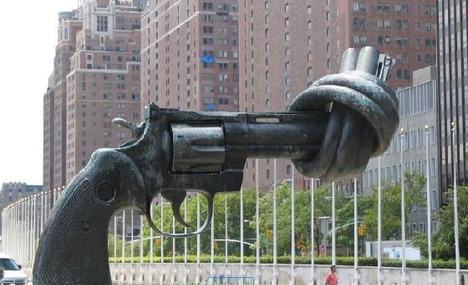
Violence, as we sadly know too well, goes well beyond war to include domestic violence, random street crime, repression, and even poverty — responsible for more death than most other forms combined. But sometimes, despite this variety, it seems that the images of violence which come quickest to our minds are that of an angry kid with a rock or a gun. Our book will try to turn that image on its head. (more…)

Nonviolent Nigeria

February 03, 2012 By: NCVeditor Category: Culture, Economy, Matt Meyer, Politics

The Roots (and Routes) of Resistance

by Matt Meyer

It is tough now to believe: Chidi Nwosu was murdered just a little over one year ago. He was hardly the first prominent Nigerian human rights leader to be assassinated, nor was he the last before the Occupy Nigeria movement of 2012 began taking to the streets, forming a new, nationwide emphasis on the need for sweeping economic and political change in one of the most populated and resource-rich corners of the planet. Nwosu, founder and president of the Human Rights, Justice and Peace Foundation (HRJPF), was a friend and colleague of the secular pacifist War Resisters International — but his death was anything but nonviolent. Tortured in his home while his wife and young daughter were locked in an adjacent room, he was shot in the head and dragged around the house as a symbol of what happens to those who dare take on questions of police misconduct, government corruption, and an end to rule by multinational corporations. It is no coincidence that this killing took place a short time after a major conference had been held (with Nwosu as central organizer), linking the issues and calling for a “total cleansing” of the Nigerian scene. (more…)

Occupied Nigeria

January 23, 2012 By: NCVeditor Category: Culture, Economy, Matt Meyer, Politics

Deploying Nonviolence Against Colonialism

by Matt Meyer

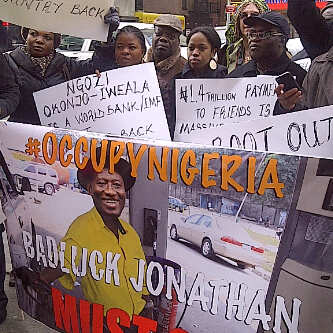
For too many expatriate Africans living in the West, the phrase Occupied Nigeria raises scary images of U.S. or NATO warships bearing down in AFRICOM-commando fashion, reestablishing Eurocentric hegemony over the worlds’ fifth largest supplier of crude oil. Before these early days of 2012, we had barely heard news of the spreading Occupy hashtag on the continent that helped re-popularize mass nonviolent civilian resistance around the world last year. Now #Occupy Nigeria in just two short weeks has mobilized thousands in cities across the diverse West African country, along with support demonstrations (including some of those ex-pats) in London, Los Angeles, New Jersey, and elsewhere. The widespread strike by Nigerian oil workers continues to grow, as calls for an end to economic and political corruption gain momentum.

The short-term issue which birthed the network now being called Occupy Nigeria was the hastily-announced January 1, 2012 end of the federal fuel subsidies which had enabled average Nigerians to afford gas pumped from oil reserves on their own land. This resulted in an overnight 120 percent price increase, and an outburst of fury at decades of governmental collusion with the multi-billion dollar oil industry. (more…)

Remembering the Lawrence Strike

January 09, 2012 By: NCVeditor Category: Economy, Jerry Elmer, Politics

On the Centennial of a Nonviolent and Decisive Workers’ Victory

by Jerry Elmer

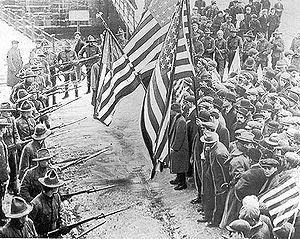
January 12, 2012 is the one hundredth anniversary of the commencement of one of the most important labor strikes in American history – the bloody 1912 Lawrence, Massachusetts, textile strike that lasted 63 days. The strike represented the organizing apogee of the radical, syndicalist Industrial Workers of the World (IWW, or Wobblies); the strike has also become associated (albeit erroneously) in popular lore with the slogan “Bread and Roses” (the phrase originated in a poem by James Oppenheim published in 1911, but was apparently never used by the Lawrence strikers in 1912).

On January 1, 1912, a new Massachusetts law had gone into effect that cut the maximum work week to 54 hours. Mill workers’ pay was given out on Fridays, not for the week just ended but for the previous week; thus, on Friday afternoon, January 12, 1912, workers received their pay for the work week of Monday, January 1 through Saturday, January 6. Workers found their pay to be an average of 32¢ short, representing the fewer hours that the mill workers had toiled. (more…)

Paying Dividends

November 08, 2011 By: NCVeditor Category: Current Events, David Swanson, Economy, Politics

Public Pressure Is Slowly Ending the War in Afghanistan

by David Swanson

Feints and baby steps in the direction of eventually ending a massive crime are not enough. Hoping to meet a distant deadline for ending a war that cannot be justified for a single day is not enough. A new misunderstanding should not be piled on top of other fictional accomplishments (the closing of Guantanamo, the complete withdrawal from Iraq, universal health coverage, etc.). But if we don’t understand that we are beginning to move things in the right direction many among us will lose heart and others will miscalculate. (more…)

Corporations Are Not People

October 17, 2011 By: NCVeditor Category: Economy, Michael N. Nagler, Politics, Stephanie N. Van Hook

We Hold These Truths to be Self-Evident…

by Michael N. Nagler and Stephanie N. Van Hook

When is a person not a person? Psychologists for Social Responsibility (PSR) recently answered this absurd question with the obvious and embarrassing answer: when it’s a corporation. According to PSR’s statement, in case anyone is confused, a human being

“is a complex organism with capacities for joy and pain, reflection, and the compassionate appreciation of others. Mature persons are expected to display reasoned judgment, and are personally responsible for their own actions (our emphasis).  Human beings live, breath, think, experience emotions, and internalize values such as empathy and caring for others. Like all sentient beings, they suffer, and die.”

Corporations possess none of these functions, which make being human sacred, valuable and worthy of dignity. As the Occupy movements grow in remarkably inspiring ways, they have a unique opportunity to raise the human image from the slander and propaganda of the corporate media — where our capacity for consumption defines us and our desire for wealth drives us — to a more promising, and far more accurate conception of what makes us truly human: our capacity for nonviolence, motivated by our most precious desire for freedom. As Gandhi put it, “Non-violence is the law of the humans…” (more…)

  • Welcome to NCV

    A (relatively) NEW blog filled with (generally) CLEAR intentions and a (positive) VISION for the future.
  • Latest Posts

  • GONE, NOT FORGOTTEN

    Since launching in 2010, we featured many inspiring writers on cutting-edge issues. In times of escalating crises, we sought to remain proactive rather than perpetually reactive, to not give more power to those who would co-opt the agenda, and to try turning visions in practice. We can critique what is and offer insights into what could be, without becoming embittered in the process. We weren't partisan, but we'll always stand on the side of those who desire peace with justice. We're not posting anymore new content as of 2017, but our archive will remain up and you can still find us on social media. We'll see you in the interwebs...
  • New! Thematic ‘Zines

  • Tags

  • Archives

  • NCV Bookmarks

    Peace Ecology
  • Green by DreamHost

    carbon neutral * renewable energy
    Green Web Hosting! This site hosted by DreamHost.