New Clear Vision

constructive commentary for the chronically farsighted
Subscribe

Getting to Know Us

February 13, 2013 By: NCVeditor Category: Culture, Ecology, Politics, Winslow Myers

A Memo to U.S. Adversaries

by Winslow Myers

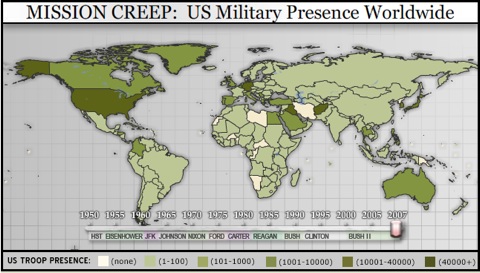
One of the first things you need to know about the U.S. is how difficult it is for us to tolerate ambiguity — especially when untangling our own motives. An example was our second invasion of Iraq. After 9/11 we felt an itch to retaliate against a clear enemy. Because we could not pinpoint one, we scratched the itch by inventing a false enemy — conveniently, one with lots of oil under its sand — and going to war against it, to no one’s great benefit.

That endeavor revealed a lot about us at this moment in our history, though similar themes can be found in our past.  We have been all too certain, like some of you, that we are exceptional, that wrongs done to us justify our flouting international law, and that violent military force is the only way to get our way. (more…)

Get into the Streets!

January 09, 2013 By: NCVeditor Category: Culture, David Swanson, Politics

Resisting Racism and Militarism in 2013

by David Swanson

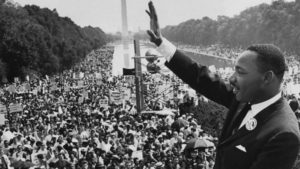
January 21st will be an odd day in the United States.  We’ll honor Martin Luther King Jr. and bestow another 4-year regime on the man who, in his Nobel peace prize acceptance speech said that Martin Luther King Jr. had been wrong — that those who follow his example “stand idle in the face of threats.”

I plan to begin the day by refusing to stand idle in the face of the threat that is President Barack Obama’s military.  An event honoring Dr. King and protesting drone wars will include a rally at Malcolm X Park and a parade named for a bit of Kingian rhetoric.

That evening I plan to attend the launch of a new book called We Have Not Been Moved: Resisting Racism and Militarism in 21st Century America.

The Martin King I choose to celebrate is not the mythical man, beloved and accepted by all during his life, interested exclusively in ending racial segregation, and not attracted to activism — since only through electoral work, as we’ve all been told, can one be a serious activist.

The Martin King I choose to celebrate is the man who resorted to the most powerful activist tools available, the tools of creative nonviolent resistance and noncooperation, in order to resist what he called the giant triplets of racism, extreme materialism, and militarism. (more…)

The Beloved Community

November 29, 2012 By: NCVeditor Category: Community, Culture, Randall Amster, Windy Cooler

Strengthening the Ties that Bind in an Era of Alienation

by Randall Amster and Windy Cooler

As we move into the winter of 2012, the days are getting shorter and the sociopolitical realities put before us seem, in some ways, to be darkening by the minute. How is it that we do not know how to live in the world, in those ways that have sustained and advanced the human experiment for eons? Today we have reactionary, regressive policies masking as “progress,” replacing the reciprocal bonds of authentic community with the wafer-thin ties of social networking and, in the process, turning our alienation and dysfunction into a nouveau spectacle. During the recent Israeli assault on Gaza, for example, a reporter for the Jerusalem Post actually asked residents in fear for their children’s lives if anyone could give an interview about how the shrieking sirens were affecting pets. It is so taboo to speak of what really matters with the people who matter that we have to be encouraged to do so. (more…)

New Revolutionary Nonviolence

September 06, 2012 By: NCVeditor Category: Culture, Matt Meyer, Politics

Dealing with Errors and Breaking with Empires

by Matt Meyer

In my recent piece Building Bridges between Principles and Practice, I noted that there were “concrete, historical incidents in which principled pacifists stuck to their ideals about not engaging in individual acts of violence, but were blinded to the larger issues of institutional violence being perpetrated against those socially considered ‘others.’” These incidents, I wrote, are seemingly more than simple coincidences:

“They suggest fault lines, especially along race and class, where one set of principles contradicted or trumped another. Sometimes without self-awareness, time and again, pacifist attempts to create a nonviolent culture (especially a single, white-washed or homogenized culture) led to acts which served to solidify institutional violence. Similarly, through ignorance or distance from those oppressed peoples struggling for justice ‘by any means necessary,’ even when they were often predominantly using nonviolent tactics, ‘First World’ pacifists missed — and still miss — the vital lessons offered by people who could easily be our closest colleagues.” (more…)

Collective Rites of Passage

May 31, 2012 By: NCVeditor Category: Culture, Guest Author, Politics

Revolution of Values, or Values for the Revolution?

by Robert Riversong

It has been said that God (good old divinity) is always whispering in our ears. If we do not hear the voice, it becomes a shout. And if we ignore the shout, we get hit over the head. There is so much din in our ever-accelerating culture that the quiet voice has been all but drowned out. For Job, it required the “voice of the whirlwind” (not the commonly mistranslated “voice in the whirlwind”) to wake him. For many of us, it has required the thundering collapse of the World Trade towers, the angry shout of Katrina, the jack-boot stomp of expanding empire and diminishing liberties or the perfect storm of peak oil, climate change, species extinction and ecological devastation to awaken us from our hypnotic trance, our sleep-walking to the edge of the cliff.

But what we seem to agree upon — those of us seeking a way out of the madness — is that the “old story” no longer supports our deepest needs nor any hope for a sustainable world, that we are in a state of Koyaanisquatsi, the Hopi word for “life out of balance.” “Yes, we did produce a near perfect Republic,” said Thomas Jefferson. “But will they keep it, or will they, in the enjoyment of plenty, lose the memory of freedom? Material abundance without character is the surest way to destruction.” (more…)

Partners in the Freedom Struggle

March 23, 2012 By: NCVeditor Category: Culture, Matt Meyer, Politics

Why Nonviolent Activists Should Follow John Brown

by Matt Meyer

“The lack of historical consensus regarding John Brown,” asserted longtime labor, racial justice, and international activist Bill Fletcher, “speaks to the ideological confusions we continue to face.” Fletcher — a columnist for Black Commentator, Senior Scholar for the Institute for Policy Studies, and former president of TransAfrica — noted that John Brown was anti-slavery, but not just that; he was anti-racist, but there were others at the time who were anti-racist as well. As Fletcher suggested that Brown’s difference was his dramatic defense of enslaved Africans, people he actually befriended and liked, he summarized the dividing line question which still remains: “Was Brown a terrorist or was he engaging in an emancipatory practice?”

This year’s Left Forum — the annual coming together of a broad spectrum of left and progressive intellectuals, activists, academics, organizations and the interested public, the largest in the US — was a different one than usual for me. Award-winning and beloved science fiction writer and old buddy Terry Bisson asked me to join his panel on a favorite topic of ours: the legacy of abolitionist John Brown. (more…)

Occupy History

December 27, 2011 By: NCVeditor Category: Culture, Current Events, Guest Author, Politics

Between the Sphinx and the Bank Vault

by Alon Raab

1929

“Between the sphinx and the bank vault, there is a taut thread that pierces the heart of all poor children,” cried Federico Garcia Lorca after visiting Wall Street in 1929. His vision sharpened by gathering storms of fascism, in his native Spain and across the European continent, compounded by new forms of corporate control in the US, and a broken heart over unrequited love, he poured his soul into the powerful “Poet in New York” poems. Visiting Wall Street, the sidewalks barely swept of fall leaves and the remains of leaping bodies — small‐time investors convinced that untold wealth shall be theirs only to see life‐savings vanish, and of the occasional banker who followed their lead ‐‐ his eyes pierced Capitalism’s many veils.

Wall Street ‐‐ built on Iroquois and Algonquin land, named for the wall that the Dutch colonists erected to keep the English and the Indians away. Soon, the Dutch West Indies Company, early and major importer of slaves, brought them to New Amsterdam, too. Auctions in human flesh were held nearby, a connection deepened by major banks and investment firms turning money from slave transactions to new gold and influence. Later, a place giving birth to economic shenanigans and scams, crises and broken dreams ‐‐ vast fortunes for the few, misery for the many. (more…)


Switch to our mobile site